
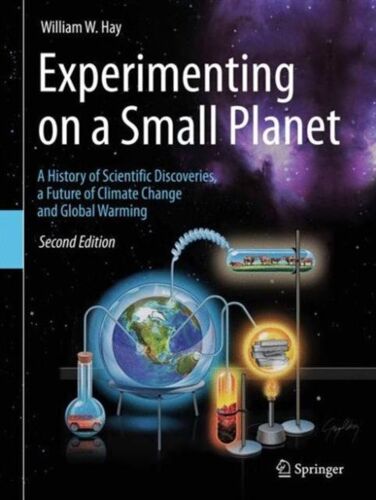
Experimenting on a Small Planet - Hay, William W.
- Format: Relié Voir le descriptif
Vous en avez un à vendre ?
Vendez-le-vôtreSoyez informé(e) par e-mail dès l'arrivée de cet article
Créer une alerte prix
- Payez directement sur Rakuten (CB, PayPal, 4xCB...)
- Récupérez le produit directement chez le vendeur
- Rakuten vous rembourse en cas de problème

Gratuit et sans engagement
Félicitations !
Nous sommes heureux de vous compter parmi nos membres du Club Rakuten !
TROUVER UN MAGASIN
Retour
Avis sur Experimenting On A Small Planet de Hay, William W. Format Relié - Livre Sciences de la vie et de la terre
0 avis sur Experimenting On A Small Planet de Hay, William W. Format Relié - Livre Sciences de la vie et de la terre
Les avis publiés font l'objet d'un contrôle automatisé de Rakuten.
Présentation Experimenting On A Small Planet de Hay, William W. Format Relié
- Livre Sciences de la vie et de la terre


Résumé :
This book is a thorough introduction to climate science and global change. The author is a geologist who has spent much of his life investigating the climate of Earth from a time when it was warm and dinosaurs roamed the land, to today's changing climate. Bill Hay takes you on a journey to understand how the climate system works. He explores how humans are unintentionally conducting a grand uncontrolled experiment which is leading to unanticipated changes. We follow the twisting path of seemingly unrelated discoveries in physics, chemistry, biology, geology, and even mathematics to learn how they led to our present knowledge of how our planet works. He explains why the weather is becoming increasingly chaotic as our planet warms at a rate far faster than at any time in its geologic past. He speculates on possible future outcomes, and suggests that nature itself may make some unexpected course corrections. Although the book is written for the layman with little knowledge of science or mathematics, it includes information from many diverse fields to provide even those actively working in the field of climatology with a broader view of this developing drama. Experimenting on a Small Planet is a must read for anyone having more than a casual interest in global warming and climate change - one of the most important and challenging issues of our time. This new edition includes actual data from climate science into 2014. Numerous powerpoint slides allow lecturers and teachers to more effectively use the book as a basis for climate change education.
Biographie:
William W. (Bill) Hay was born October 12, 1934, in Dallas, Texas. He received his B.S. in Biology from Southern Methodist University in 1955, M.S. in Geology from the University of Illinois at Urbana in 1958, and Ph.D. in Geology from Stanford University in 1960. As an undergraduate and graduate student he also studied at Ludwig-Maximillian's University in Munich under Wayne University's Junior Year in Munich program, and the University of Zurich as a Fellow of the Swiss Friends of the USA. Afer a year of postdoctoral study at the University of Basel, Switzerland, he began his professional career at the University of Illinois in Urbana in 1960. In 1968 he become a joint Professor of Geology at the University of Illinois and Professor of Marine Geology and Geophysics at the Rosenstiel School of Marine and Atmospheric Sciences (RSMAS) of the University of Miami. He maintained this joint arrangement until 1974. From 1974-76 he served as Chairman of the Division of Marine Geology and Geophysics, and from 1976-1980 as Dean of RSMAS. From 1979 to 1982 he served as President of Joint Oceanographic Institutions, Inc. in Washington, D.C. In 1982 he moved to Boulder, Colorado as Director of the University Museum, and was soon added to the faculty of Geology and CIRES. He resigned as Director of the Museum in 1987, and from 1990 to 1998 was on a half -time appointment at Colorado and half-time as Gastprofessor at GEOMAR, a marine geological research institute attached to Christian-Albrecht's-Universit?t, Kiel, Germany. In 1991-92 he was an Alexander von Humboldt Senior Research Scientist. In the summer of 1993 he was Gastprofessor in the Sektion Marine Geologie, Institute for Baltic Sea Research in Warnem?nde, Germany, and in the fall of the same year F. C. Donders Professor at the Institute of Earth Sciences, University of Utrecht, The Netherlands. In the fall of 1995 and again in 2010 he was Gastprofessor, sponsored by the University of Vienna, in the University's Institut f?r Pal?ontologie, Vienna, Austria. During the fall of 1996 he was Gastwissenschaftler, sponsored by the Deutsche Forschungsgemeinschaft, at the Institute for Baltic Sea Research in Warnem?nde/Rostock and Gastprofessor at Ernst-Moritz-Arndt University in Greifswald, Germany. During the summer and fall of 1997 he was Gastprofessor at GEOMAR, Christian-Albrecht's-University, Kiel, Germany. He retired from the University of Colorado in 1998 to take on the role of Professor of Paleoceanology full time at GEOMAR. He retired from GEOMAR in June 2002. He is Professor Emeritus at the University of Colorado, and now lives in Estes Park, Colorado. His current special interests are in global paleoclimatic and paleoceanographic modeling...
Sommaire:
This book is a thorough introduction to climate science and global change. The author is a geologist who has spent much of his life investigating the climate of Earth from a time when it was warm and dinosaurs roamed the land, to today's changing climate. Bill Hay takes you on a journey to understand how the climate system works. He explores how humans are unintentionally conducting a grand uncontrolled experiment which is leading to unanticipated changes. We follow the twisting path of seemingly unrelated discoveries in physics, chemistry, biology, geology, and even mathematics to learn how they led to our present knowledge of how our planet works. He explains why the weather is becoming increasingly chaotic as our planet warms at a rate far faster than at any time in its geologic past. He speculates on possible future outcomes, and suggests that nature itself may make some unexpected course corrections. Although the book is written for the layman with little knowledge of science or mathematics, it includes information from many diverse fields to provide even those actively working in the field of climatology with a broader view of this developing drama. Experimenting on a Small Planet is a must read for anyone having more than a casual interest in global warming and climate change - one of the most important and challenging issues of our time. This new edition includes actual data from climate science into 2014. Numerous powerpoint slides allow lecturers and teachers to more effectively use the book as a basis for climate change education....