
219,99 €
Produit Neuf
Ou 55,00 € /mois
- Livraison : 25,00 €
- Livré entre le 5 et le 10 octobre
Apres acceptation de la commande, le delai moyen d'expedition depuis le Japon est de 48 heures. Le delai moyen de livraison est de 3 a 4 semaines. En cas de circonstances exceptionnelles, les delais peuvent s'etendre jusqu'à 2 mois.

- Payez directement sur Rakuten (CB, PayPal, 4xCB...)
- Récupérez le produit directement chez le vendeur
- Rakuten vous rembourse en cas de problème

Gratuit et sans engagement
Félicitations !
Nous sommes heureux de vous compter parmi nos membres du Club Rakuten !
TROUVER UN MAGASIN
Retour
Avis sur Treasure Your Exceptions de Forsdyke, Donald R. Format Relié - Livre Beaux arts
0 avis sur Treasure Your Exceptions de Forsdyke, Donald R. Format Relié - Livre Beaux arts
Les avis publiés font l'objet d'un contrôle automatisé de Rakuten.
-
Pierre Bayle
Neuf dès 222,62 €
-
The Fourth World Omnibus Vol. 2
Neuf dès 134,88 €
-
By Marc Pairon Art Deco Ceramics Made In Belgium: Charles Catteau
6 avis
Occasion dès 110,00 €
-
Thinking Is Form: The Drawings Of Joseph Beuys
Occasion dès 255,99 €
-
Quantum Electrodynamics Of Strong Fields
Neuf dès 211,28 €
-
Geometric Quantization And Quantum Mechanics
Neuf dès 123,61 €
-
Advanced Quantum Mechanics
Neuf dès 145,54 €
-
Common Sense
Occasion dès 115,00 €
-
Custom Lettering Of The '60s & '70s
Occasion dès 162,00 €
-
Diego Rivera. The Complete Murals
Neuf dès 212,44 €
-
Flashpoint: The 10th Anniversary Omnibus
Neuf dès 158,71 €
-
Hitman By Garth Ennis And John Mccrea Omnibus Vol. 2
Neuf dès 114,69 €
-
Bay Area Graffiti 80-90
1 avis
Occasion dès 325,99 €
-
Monster Hunter: World - Official Complete Works
1 avis
Neuf dès 223,99 €
-
Art Of Sea Of Thieves
1 avis
Neuf dès 127,99 €
-
Angry Women (Re/Search ; 13)
Occasion dès 113,99 €
-
Lawrence Weiner: Displacement
Occasion dès 207,99 €
-
Soviet Military Deception In The Second World War
Neuf dès 195,80 €
-
Norstedts Stora Svensk-Engelska Ordbok : Norstedts Comprehensive Swedish-English Dictionary
Occasion dès 205,00 €
-
Art+Com
Occasion dès 155,99 €
Produits similaires
Présentation Treasure Your Exceptions de Forsdyke, Donald R. Format Relié
- Livre Beaux arts


Résumé :
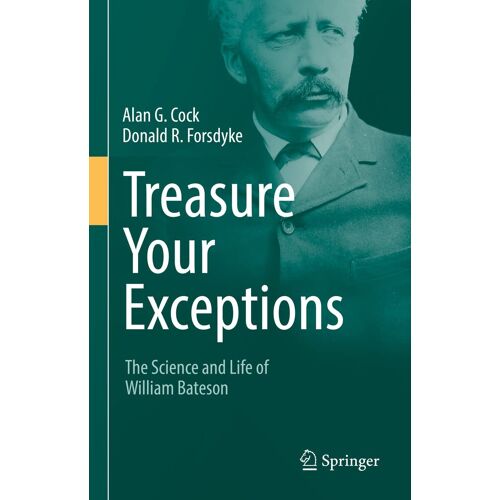
William Bateson brought the work of Mendel (and much more) to the attention of the English-speaking world. He commanded the biological sciences in the decades after Darwin's death in 1882. To understand these years we must first understand Bateson. Through examination of the life of a major contributor to the turn-of-the-nineteenth-century revolution in biology, the authors reconcile the genocentrism of George Williams and Richard Dawkins with the hierarchical thinking of Richard Goldschmidt and Stephen Jay Gould. Aided by Rebecca Saunders, Bateson invented much of the basic terminology of modern genetics and, when addressing Darwin's great problem - the origin of species, introduced the mysterious term the residue. While the first edition of this work (2008) related residue to relative concentrations of bases in DNA, the second edition reveals this as reflecting fundamental differences in short strings of bases. Thus, the book has come to represent not only Bateson's science and life, but also a revised history of the biosciences that is likely to be increasingly visited, both by scientists and by those who wish to fully understand contemporary debates on racial, eugenic and gender aspects of genetics. In a nutshell, the book describes what we, in modern terms, would call a colossal intelligence failure. Mendel handed it to us on a plate in 1865 when Bateson was only 4. It took 35 years to join the dots with Bateson a primary joiner. Shrugged off by many 20th century scientists as a freak blip in what was really an orderly advance, the Mendel episode was but one of a succession of such blips. Thus, a multiplicity of post-Mendelian Mendels emerge as the story of Bateson's life unfolds. Peter Harper in Human Genetics (2009): This book puts the record straight and one is left with a feeling of admiration for Bateson as both a scientist and a man, and with no doubt that he, more than anyone else, was largely responsible for the rapid progress in modern genetics during the first decade of the twentieth century. Michael J. Wade in Evolution (2009): I strongly recommend this book for its information on an important central figure and for its bringing to life the several controversies at the origins of Genetics. It greatly illuminates the conceptual foundations of evolutionary genetics. Elof Axel Carlson in Quarterly Review of Biology (2009): This volume will be of enormous benefit to historians of science who like to follow how ideas are born or die and why participants of different sides of each controversy held such rigid views of their own work and saw little merit in their competitor's research. Joel S. Schwartz in Choice (2009): This work includes key events in Bateson's career and is strengthened by discussion of the rediscovery of Mendelian principles by early 20th-century geneticists. Its basic premise isthat Bateson was not merely one of the founders of genetics but played a pivotal role in the development of evolutionary biology by serving as the link between Victorian naturalists and early 20th-century biologists. Amitabh Joshi in Journal of Genetics (2010): There is much in this book that I was not aware of, despite a formal training in genetics and a strong amateur interest in the history of biology.... It is certainly a book that any serious student of either genetics or evolution would greatly benefit from reading. ...
Biographie:
Q. Rev. Biol. 1966 41, 131-190). In the 1970s he repatriated, curated and catalogued the papers of William Bateson, and wrote several important papers on, and initiated a definitive biographyof, Bateson (later coauthored with Forsdyke). He corresponded and/or collaborated with many important mid-late-20th century figures. Donald Forsdyke was born in London, UK (1938), and has degrees in Medicine (St. Mary's Hospital Medical School) and in Biochemistry (Ph.D, Cambridge University). He has engaged in research and teaching at the Department of Biochemistry, Queen's University, Kingston, Canada, since 1968. His research includes the concept and mechanism of positive selection of lymphocyte repertoires, discovery of the lectin pathway of complement activation, identification of lymphocyte activation genes, bioinformatic analyses of DNA sequences relating to introns and speciation, and biohistory with special reference to evolutionary biology and the roles of George Romanes, William Bateson and Samuel Butler. His interest in history derives from a belief that understanding how science has progressed in the past will aid its progress in the future....
Sommaire:
Alan Cock (1926-2005) was a son-in-law of a colleague of Tschermak, one of the botanist rediscoverers of Mendel. His undergraduate studies in Zoology at Cambridge led to work with Michael Pease (1947-57) at the Agricultural Research Council Poultry Genetics Unit. Since Pease had himself assisted Punnett, who was Bateson's main assistant, then Alan can be seen as Bateson's scientific great grandson. After doctoral work in Genetics (Edinburgh 1962), he became lecturer in Zoology at the University of Southampton. In the early, pre-history, phase of his career, his work with Morten Simonsen provided a fundamental understanding of the graft-versus-host reaction (Immunology 1958 1, 103-110). In the 1960s he and Stephen Jay Gould were leaders in studies of animal growth and form (allometry...
Détails de conformité du produit
Personne responsable dans l'UE