
122,31 €
Produit Neuf
Ou 30,58 € /mois
- Livraison : 3,99 €
- Livré entre le 22 et le 28 août
Nos autres offres
-
245,99 €
Produit Neuf
Ou 61,50 € /mois
- Livraison : 25,00 €
- Livré entre le 5 et le 10 septembre
Apres acceptation de la commande, le delai moyen d'expedition depuis le Japon est de 48 heures. Le delai moyen de livraison est de 3 a 4 semaines. En cas de circonstances exceptionnelles, les delais peuvent s'etendre jusqu'à 2 mois.
Voir le détail de l'annonce

- Payez directement sur Rakuten (CB, PayPal, 4xCB...)
- Récupérez le produit directement chez le vendeur
- Rakuten vous rembourse en cas de problème

Gratuit et sans engagement
Félicitations !
Nous sommes heureux de vous compter parmi nos membres du Club Rakuten !
TROUVER UN MAGASIN
Retour
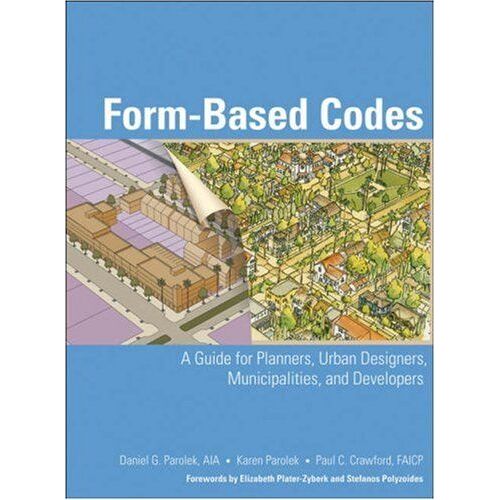
Avis sur Form - Based Codes de Daniel G Parolek Format Relié - Livre
0 avis sur Form - Based Codes de Daniel G Parolek Format Relié - Livre
Les avis publiés font l'objet d'un contrôle automatisé de Rakuten.
Présentation Form - Based Codes de Daniel G Parolek Format Relié
- Livre


Résumé :
A comprehensive, illustrative guide to Form-Based Codes
This volume describes in clear argument and significant detail the issues and techniques associated with the design and management of Form-Based Codes as an antidote to zoning and sprawl. Reading it and putting it to practice is an excellent point of departure for individuals and municipalities to safeguard and to grow their communities.
- From the Foreword by noted architect and urbanist Stefanos Polyzoides
Form-Based Codes are the latest evolutionary step in the practice of development and land-use regulation. A growing alternative to conventional zoning laws, Form-Based Codes go beyond land use to address not just the physical form of buildings but also surrounding streets, blocks, and public spaces in order to create, protect, and revitalize sustainable communities.
Written by three recognized leaders in the field of New Urbanism, including an urban planner and an architect, this book is the first to address this subject comprehensively. After defining Form-Based Codes and explaining why they are a necessary alternative to conventional zoning regulations, the authors detail the various components of Form-Based Codes and then go step by step through the process of creating and implementing them. Finally, a series of case studies illustrates best practice applications of Form-Based Coding at various scales from county-wide to site specific, and various project types from city-wide development code replacement to the preservation or evolution of downtowns.
This timely and accessible text features:
* More than 200 clear illustrations of Form-Based Codes
* Studies of real-world applications of Form-Based Coding by leading planners, urban designers, and architects
Form-Based Codes is a must-read for today's urban designers, urban planners, architects, and anyone with a vested interest in utilizing the latest regulatory tool to help create compact, walkable, and sustainable communities....
Biographie: Daniel G. Parolek, AIA, and KAREN PAROLEK are principals in Opticos Design, established in 2000 in Berkeley, California, as a multidisciplinary firm specializing in architecture, urban design, information design, and Form-Based Code design. They are both on the founding board of directors of the Form-Based Codes Institute. Daniel G. Parolek is an architect who has worked on some of the most innovative New Urbanist projects and Form-Based Codes in California and across the United States. He is a frequent national lecturer and author in the field of New Urbanism, Smart Growth, and Form-Based Codes. Karen Parolek is an information architect who strives to improve visual methods of communication on projects ranging from a wayfinding signage system for downtown New York City (while working at Pentagram Design) to Web site metadata schemas. Her most recent focus has been on the practice of Form-Based Coding. Paul C. Crawford, FAICP, is a principal with Crawford Multari & Clark Associates in San Luis Obispo, California, and the founding board chair of the Form-Based Codes Institute. Crawford is a nationally recognized zoning expert who has personally worked on more than twenty-five Form-Based Codes, more than 100 zoning and development codes overall, and more than thirty general plans. Paul was planning director for San Luis Obispo County from 1980 to 1990, and served as adjunct professor of city and regional planning at California Polytechnic State University in San Luis Obispo from 1980 to 2006.
Sommaire: Foreword: An Optimistic Moment by Elizabeth Plater-Zyberk ix 1 / Introduction 1 2 / Components 15 3 / Process 95 4 / Case Studies 187 Appendix 311
Foreword: The Time Is Now by Stefanos Polyzoides xiii
Acknowledgments xix
Why Form-Based Codes? 3
A Brief History of Zoning 6
A New Approach 11
Scope of Th is Book 13
The Regulating Plan 17
Public Space Standards 28
Building Form Standards 39
Frontage Type Standards 59
Block Standards 62
Building Type Standards 64
Architectural Standards 78
Code Administration 88
Pre-Phase 1: Scoping 98
Phase 1: Documenting 108
1.1 Macro Scale 111
1.1.1 Gather Background Documents 114
1.1.2 Create Base Drawings 115
1.1.3 Analyze Compiled Materials 117
1.1.4 Visit the Site 118
1.1.5 Organize the Data 122
1.1.6 Analyze the Data 124
1.1.7 Present to Stakeholders 124
1.2 Micro Scale 126
1.2.1 Select Sampling Areas 127
1.2.2 Prepare Site Visit Materials 127
1.2.3 Visit the Site 128
1.2.4 Organize the Data 132
1.2.5 Analyze the Data 132
1.2.6 Repeat for Other Micro Elements 135
Phase 2: Visioning 144
2.1 Illustrative Plan and Imagery 147
2.1.1 Hold a Kickoff Meeting 148
2.1.2 Locate the Macro Elements 148
2.1.3 Locate the Micro Elements 149
2.1.4 Illustrate the Transect Zones 149
2.1.5 Illustrate the Micro Elements 151
2.2 Regulating Plan and Regulations 152
2.2.1 Create the Transect Regulation Matrix 154
2.2.2 Select a Neighborhood 161
2.2.3 Draw the Boundary of the Regulating Zone 161
2.2.4 Add a Transect Zone to the Matrix 161
2.2.5 Review the Transect Zone Regulations 162
2.2.6 Duplicate the Transect Zone on the Matrix 163
2.2.7 Modify the Transect Zone Regulations 164
2.2.8 Finalize the Regulating Zone 164
2.2.9 Review the Regulating Plan 164
2.2.10 Resolve the Outer Area Boundaries 164
2.2.11 Review the Transect Regulation Matrix 165
2.2.12 Repeat for Micro Elements 165
2.2.13 Write the Development Review Process 166
2.2.14 Assemble the Vision Plan 166
Phase 3: Assembling 168
3.1 Splicing 170
3.2 Formatting 171
3.2.1 Organize the Content 174
3.2.2 Write Additional Content 177
3.2.3 Create Graphics 177
3.2.4 Create Page Templates 181
3.2.5 Transfer the Content 184
Color Images 189
Santa Ana Downtown Renaissance Specific Plan (Santa Ana, California) 205
Downtown Master Plan and Form-Based Code (Benicia, California) 217
Miami 21 SmartCode (Miami, Florida) 227
Development Code Update and Form-Based Code (Grass Valley, California) 239
TOD SmartCode (Leander, Texas) 249
Heart of Peoria Land Development Code (Peoria, Illinois) 259
Form-Based Code for Mixed-Use Infill (Sarasota County, Florida) 269
Towns, Villages, and Countryside (St. Lucie County, Florida) 279
Ventura, California 289
Montgomery, Alabama 301
Abbreviated Timeline of Form-Based Coding 313
Common Mistakes 316
References 319
End Notes 323
Index 325
Détails de conformité du produit
Personne responsable dans l'UE