
56,56 €
Produit Neuf
Ou 14,14 € /mois
- Livraison : 3,99 €
- Livré entre le 19 et le 26 septembre

- Payez directement sur Rakuten (CB, PayPal, 4xCB...)
- Récupérez le produit directement chez le vendeur
- Rakuten vous rembourse en cas de problème

Gratuit et sans engagement
Félicitations !
Nous sommes heureux de vous compter parmi nos membres du Club Rakuten !
TROUVER UN MAGASIN
Retour
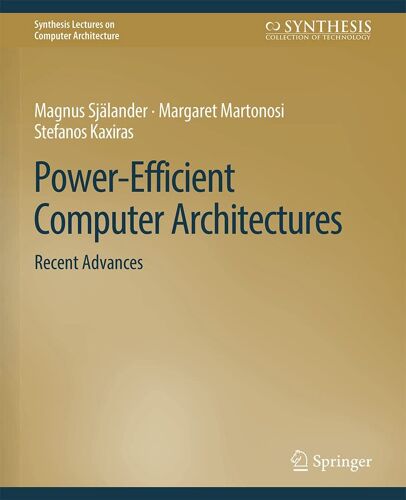
Avis sur Power - Efficient Computer Architectures de Själander, Magnus Format Broché - Livre Littérature Générale
0 avis sur Power - Efficient Computer Architectures de Själander, Magnus Format Broché - Livre Littérature Générale
Les avis publiés font l'objet d'un contrôle automatisé de Rakuten.
-
Sf2a : Scientific Highlights 2004
Occasion dès 69,00 €
-
Diagrammatic Chart Of World History 5000 Years Of History
Occasion dès 29,90 €
-
Les Clés De L'allemand D'aujourd'hui - 408 Repères Grammaticaux
2 avis
Occasion dès 37,00 €
-
Paroissien Romain - Chant Grégorien - Contenant La Messe Et L'office Pour Les Dimanches Et Les Fête - 1936 - Desclée & Cie
Occasion dès 30,00 €
-
German Guided Missiles Of The Second World War
Occasion dès 30,90 €
-
La Version Allemande Systématique
2 avis
Occasion dès 45,80 €
-
Sony A99 Ii
Neuf dès 56,83 €
Occasion dès 34,23 €
-
Entreprise Et Environnement - Une Synergie Nouvelle
1 avis
Occasion dès 35,80 €
-
The Kitchen Diaries Ii
Neuf dès 89,80 €
Occasion dès 31,20 €
-
Litteratures Allemandes - Anthologie Et Méthodes D'approche Des Textes, 2ème Édition
2 avis
Occasion dès 36,27 €
-
Complete Masterworks
3 avis
Neuf dès 41,22 €
-
Deep Learning With Python
Occasion dès 36,66 €
-
Nouveau Testament Occitan & Rituel Cathare Xiiie Siècle, Transcription Yvan Roustit
Occasion dès 39,89 €
-
Co-Creative Science
Occasion dès 39,39 €
-
Grant Wood
Neuf dès 38,41 €
-
New Headway Pre-Intermediate - Workbook Without Answers
Occasion dès 29,43 €
-
Terraform: Up And Running
Neuf dès 71,91 €
Occasion dès 39,18 €
-
Morgan 4/4
Neuf dès 35,47 €
-
Frans Post 1612-1680
Neuf dès 99,00 €
Occasion dès 38,07 €
-
La Leçon D'allemand Systématique - Classes Préparatoires, Classes Terminales
Occasion dès 30,90 €
Produits similaires
Présentation Power - Efficient Computer Architectures de Själander, Magnus Format Broché
- Livre Littérature Générale


Résumé :
As Moore's Law and Dennard scaling trends have slowed, the challenges of building high-performance computer architectures while maintaining acceptable power efficiency levels have heightened. Over the past ten years, architecture techniques for power efficiency have shifted from primarily focusing on module-level efficiencies, toward more holistic design styles based on parallelism and heterogeneity. This work highlights and synthesizes recent techniques and trends in power-efficient computer architecture. Table of Contents: Introduction / Voltage and Frequency Management / Heterogeneity and Specialization / Communication and Memory Systems / Conclusions / Bibliography / Authors' Biographies
Biographie:
Magnus Sjalander is a Research Associate at Uppsala University. He received both his Ph.D. degree (2008) and Lic.Eng. degree (2006) in Computer Engineering from Chalmers University of Technology, Sweden. He has been a visiting researcher at NXP Semiconductors, worked at Aeroflex Gaisler, been a post-doctoral researcher at Chalmers University of Technology, and a research scientist at Florida State University. Sjalander's research interests include energy-efficient computing, high-performance and low-power digital circuits, micro-architecture and memory-system design, and hardware-software interaction.
Détails de conformité du produit
Personne responsable dans l'UE