
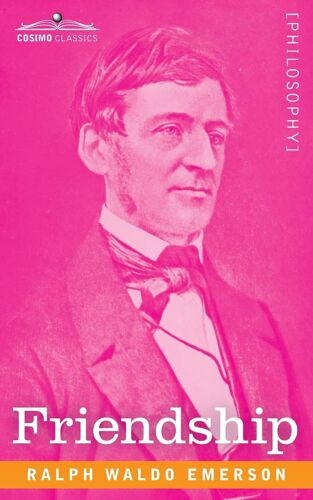
Friendship - Emerson, Ralph Waldo
- Format: Broché Voir le descriptif
Vous en avez un à vendre ?
Vendez-le-vôtre22,19 €
Produit Neuf
- Livraison à 0,01 €
- Livré entre le 31 juillet et le 12 août
Brand new, In English, Fast shipping from London, UK; Tout neuf, en anglais, expédition rapide depuis Londres, Royaume-Uni;ria9781646795161_dbm

- Payez directement sur Rakuten (CB, PayPal, 4xCB...)
- Récupérez le produit directement chez le vendeur
- Rakuten vous rembourse en cas de problème

Gratuit et sans engagement
Félicitations !
Nous sommes heureux de vous compter parmi nos membres du Club Rakuten !
TROUVER UN MAGASIN
Retour
Avis sur Friendship Format Broché - Livre Sciences de la vie et de la terre
0 avis sur Friendship Format Broché - Livre Sciences de la vie et de la terre
Les avis publiés font l'objet d'un contrôle automatisé de Rakuten.
-
Switch
1 avis
Neuf dès 28,00 €
Occasion dès 14,00 €
-
The Velvet Rage
Neuf dès 33,11 €
-
Essential Grammar In Use With Answers - A Self-Study Reference And Practice Book For Elementary Learners Of English
Occasion dès 23,30 €
-
La Femme-Ciseaux & Autres Nouvelles
Occasion dès 14,90 €
-
Les Bacchantes, Tome Vi
Occasion dès 25,80 €
-
The Literary Guide - A Guide To The Literature Of The United Kingdom, The United States And The Commonwealth 1000-2000
Neuf dès 20,90 €
Occasion dès 13,26 €
-
L'apache Juh - Mentor De Géronimo
Neuf dès 16,00 €
-
Outsphere 4: Ordres Et Chaos
Occasion dès 15,49 €
-
Caecilians Of The World - Gymnophiones Du Monde
Occasion dès 15,00 €
-
Concise Oxford English Dictionary 11th Edition
13 avis
Occasion dès 16,90 €
-
Norman Jewison
Neuf dès 31,39 €
-
My 60 Memorable Games
2 avis
Neuf dès 25,91 €
-
La Bible Officielle Du Test Toeic - Le Meilleur Tout-En-Un Pour Réussir ! (4 Cd Audio)
15 avis
Occasion dès 28,00 €
-
The Penguin History Of The World
Neuf dès 31,29 €
-
Six Pillars Of Self-Esteem
1 avis
Neuf dès 34,41 €
Occasion dès 11,11 €
-
El Ruido De Las Cosas Al Caer / The Sound Of Things Falling
Neuf dès 18,42 €
Occasion dès 13,95 €
-
The Art Of How To Train Your Dragon
5 avis
Neuf dès 46,30 €
Occasion dès 25,32 €
-
Speed Picking - Frank Gambale Book/Online Audio
Neuf dès 28,37 €
Occasion dès 78,99 €
-
Team Topologies
Neuf dès 27,09 €
-
Oral Capes Maths: Exposés 2020 / Volume 1
Occasion dès 16,95 €
Produits similaires
Présentation Friendship Format Broché
- Livre Sciences de la vie et de la terre


Résumé :
The only reward of virtue is virtue; the only way to have a friend is to be one. -Ralph Waldo Emerson, Friendship Emerson's essay on Friendship (1841) is essentially a tribute to the ways friendship enhances human lives. In it, he stresses the happiness that two people who meet on common ground can experience. As friendships grow, both parties learn to appreciate and admire the assets and accomplishments of the other and experience joy by observing their successes, according to Emerson. In the presence of a friend, there is no winter and no night; all tragedies, all ennuis vanish.
Biographie:
Ralph Waldo Emerson was an American essayist, lecturer, philosopher, and poet who led the transcendentalist movement of the mid-19th century. He was seen as a champion of individualism and a prescient critic of the countervailing pressures of society, and he disseminated his thoughts through dozens of published essays and more than 1,500 public lectures across the United States.Emerson gradually moved away from the religious and social beliefs of his contemporaries, formulating and expressing the philosophy of transcendentalism in his 1836 essay Nature. Following this work, he gave a speech entitled The American Scholar in 1837, which Oliver Wendell Holmes Sr. considered to be America's intellectual Declaration of Independence.Emerson wrote most of his important essays as lectures first and then revised them for print. His first two collections of essays, Essays: First Series (1841) and Essays: Second Series (1844), represent the core of his thinking. They include the well-known essays Self-Reliance, The Over-Soul, Circles, The Poet, and Experience. Together with Nature, these essays made the decade from the mid-1830s to the mid-1840s Emerson's most fertile period. Emerson wrote on a number of subjects, never espousing fixed philosophical tenets, but developing certain ideas such as individuality, freedom, the ability for mankind to realize almost anything, and the relationship between the soul and the surrounding world. Emerson's nature was more philosophical than naturalistic: Philosophically considered, the universe is composed of Nature and the Soul. Emerson is one of several figures who took a more pantheist or pandeist approach by rejecting views of God as separate from the world.[6]He remains among the linchpins of the American romantic movement,[7] and his work has greatly influenced the thinkers, writers and poets that followed him. When asked to sum up his work, he said his central doctrine was the infinitude of the private man. Emerson is also well known as a mentor and friend of Henry David Thoreau, a fellow transcendentalist.Ralph Waldo Emerson (May 25, 1803 - April 27, 1882)[5] was an American essayist, lecturer, philosopher, and poet who led the transcendentalist movement of the mid-19th century. He was seen as a champion of individualism and a prescient critic of the countervailing pressures of society, and he disseminated his thoughts through dozens of published essays and more than 1,500 public lectures across the United States.Emerson gradually moved away from the religious and social beliefs of his contemporaries, formulating and expressing the philosophy of transcendentalism in his 1836 essay Nature. Following this work, he gave a speech entitled The American Scholar in 1837, which Oliver Wendell Holmes Sr. considered to be America's intellectual Declaration of Independence.[6]Emerson wrote most of his important essays as lectures first and then revised them for print. His first two collections of essays, Essays: First Series (1841) and Essays: Second Series (1844), represent the core of his thinking. They include the well-known essays Self-Reliance,[7] The Over-Soul, Circles, The Poet, and Experience. Together with Nature,[8] these essays made the decade from the mid-1830s to the mid-1840s Emerson's most fertile period. Emerson wrote on a number of subjects, never espousing fixed philosophical tenets, but developing certain ideas such as individuality, freedom, the ability for mankind to realize almost anything.
Détails de conformité du produit
Personne responsable dans l'UE