
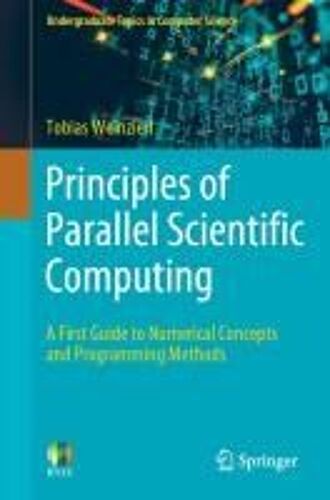
Principles of Parallel Scientific Computing - Weinzierl, Tobias
- Format: Broché Voir le descriptif
Vous en avez un à vendre ?
Vendez-le-vôtre60,19 €
Produit Neuf
Ou 15,05 € /mois
- Livraison : 3,99 €
- Livré entre le 27 juillet et le 3 août
Nos autres offres
-
74,08 €
Produit Neuf
Ou 18,52 € /mois
- Livraison à 0,01 €
Nouvel article expédié dans le 24H à partir des Etats Unis Livraison au bout de 14 à 21 jours ouvrables.
Voir le détail de l'annonce -
79,86 €
Produit Neuf
Ou 19,97 € /mois
- Livraison à 0,01 €
- Livré entre le 28 juillet et le 10 août
Brand new, In English, Fast shipping from London, UK; Tout neuf, en anglais, expédition rapide depuis Londres, Royaume-Uni;ria9783030761936_dbm
Voir le détail de l'annonce -
80,70 €
Produit Neuf
Ou 20,18 € /mois
- Livraison : 5,00 €
- Livré entre le 27 juillet et le 1 août
Exp¿di¿ en 7 jours ouvr¿s
Voir le détail de l'annonce -
92,84 €
Produit Neuf
Ou 23,21 € /mois
- Livraison à 0,01 €
Expédition rapide et soignée depuis l`Angleterre - Délai de livraison: entre 7 et 15 jours ouvrés.
Voir le détail de l'annonce

- Payez directement sur Rakuten (CB, PayPal, 4xCB...)
- Récupérez le produit directement chez le vendeur
- Rakuten vous rembourse en cas de problème

Gratuit et sans engagement
Félicitations !
Nous sommes heureux de vous compter parmi nos membres du Club Rakuten !
TROUVER UN MAGASIN
Retour
Avis sur Principles Of Parallel Scientific Computing Format Broché - Livre
0 avis sur Principles Of Parallel Scientific Computing Format Broché - Livre
Les avis publiés font l'objet d'un contrôle automatisé de Rakuten.
Présentation Principles Of Parallel Scientific Computing Format Broché
- Livre


Résumé :
New insight in many scientific and engineering fields is unthinkable without the use of numerical simulations running efficiently on modern computers. The faster we get new results, the bigger and accurate are the problems that we can solve. It is the combination of mathematical ideas plus efficient programming that drives the progress in many disciplines. Future champions in the area thus will have to be qualified in their application domain, they will need a profound understanding of some mathematical ideas, and they need the skills to deliver fast code. The present textbook targets students which have programming skills already and do not shy away from mathematics, though they might be educated in computer science or an application domain. It introduces the basic concepts and ideas behind applied mathematics and parallel programming that we need to write numerical simulations for today?s multicore workstations. Our intention is not to dive into one particular applicationdomain or to introduce a new programming language ? we lay the generic foundations for future courses and projects in the area. The text is written in an accessible style which is easy to digest for students without years and years of mathematics education. It values clarity and intuition over formalism, and uses a simple N-body simulation setup to illustrate basic ideas that are of relevance in various different subdomains of scientific computing. Its primary goal is to make theoretical and paradigmatic ideas accessible to undergraduate students and to bring the fascination of the field across.
Biographie:
Tobias Weinzierl is Professor in the Department of Computer Science at Durham University, Durham, UK. He has served at the Munich Centre for Advanced Computing (see the Springer edited book, Advanced Computing) before, and holds a PhD and habilitation from the Technical University Munich.
Sommaire:
1. The Pillars of Science.- 2. Moore Myths.- 3. Our Model Problem.- 4. Floating Point Numbers.- 5. A Simplistic Machine Model.- 6. Round-off Error Propagation.- 7. SIMD Vector Crunching.- 8. Arithmetic Stability of an Implementation.- 9. Vectorisation of the Model Problem.- 10. Conditioning and Well-posedness.- 11. Taylor Expansion.- 12. Ordinary Differential Equations.- 13. Accuracy and Appropriateness of Numerical Schemes.- 14. Writing Parallel Codes.- 15. Upscaling Methods.- 16. OpenMP Primer.- 17. Shared Memory Tasking.- 18. GPGPUs with OpenMP.- 19. Higher Order Methods.- 20. Adaptive Time Stepping.
Détails de conformité du produit
Personne responsable dans l'UE