
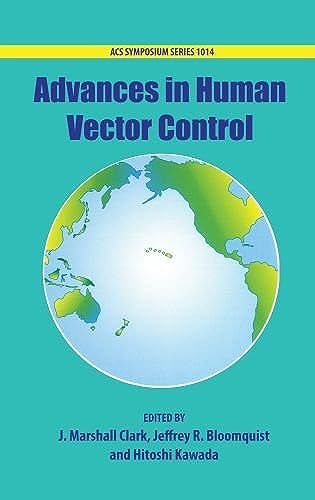
Advances in Human Vector Control -
- Format: Relié Voir le descriptif
Vous en avez un à vendre ?
Vendez-le-vôtreSoyez informé(e) par e-mail dès l'arrivée de cet article
Créer une alerte prix
- Payez directement sur Rakuten (CB, PayPal, 4xCB...)
- Récupérez le produit directement chez le vendeur
- Rakuten vous rembourse en cas de problème

Gratuit et sans engagement
Félicitations !
Nous sommes heureux de vous compter parmi nos membres du Club Rakuten !
TROUVER UN MAGASIN
Retour
Avis sur Advances In Human Vector Control de Collectif Format Relié - Livre
0 avis sur Advances In Human Vector Control de Collectif Format Relié - Livre
Les avis publiés font l'objet d'un contrôle automatisé de Rakuten.
Présentation Advances In Human Vector Control de Collectif Format Relié
- Livre


Résumé :
A combination of population growth, public health failures, environmental degradation and rapid global transportation has resulted in a world that is at increasing risk to vectorborne and other infectious diseases. A large percentage of emerging diseases are vectorborne and over one-third of the agents on the list of greatest concern from bioterrorism are vectorborne. Many of these diseases are viral that have no effective drug or vaccine treatments. Drug and insecticide resistance is now common and has greatly compromised our ability to provide effective and affordable control. Parasitic diseases, including malaria, leishmmaniasis and African trypanosomiasis are likewise increasing in many parts of the world. Control programs for onchocerciasis and to some extent filariasis are reducing the impact of these diseases, largely due to the availability of filaricides such as ivermectin. Chagas disease has also declined significantly through home improvements and indoor insecticide application against the domicilary kissing bug vectors. Despite these gains, this trend has not been sustainable. Instead, infectious disease is now responsible for greater than 25% of all deaths and nearly 50% of premature deaths among those under 45 years of age, and 63% for children less than 4 years of age. A significant proportion of these deaths is attributed to vectorborne diseases, particularly from malaria (~11%). Indeed, more that 1 million people are killed annually by malaria, about 3000 per day. It is estimated that ~700,000 children under the age of 5 die of malaria and at least 300 million are ill due to malaria each year. In response, the American Institute of Medicine (2003) has called for a renewed effort to rebuild public health infrastructures needed to conduct disease surveillance and vector control programs and to increase research to provide improved pesticides and their use, new repellents, new biopestcides and biocontrol agents to augment pesticidal control, as well as novel strategies to interrupt pathogen transmission. With these goals in mind, we convened the first vector control symposium as part of the scientific program of the 3rd Pan-Pacific Conference of Pesticide Science in 2003. Five years after (2008), we re-convened this expanded topic at the 4th Pan-Pacific Conference on Pesticide Science and the scientific presentations made over two days comprise this current volume, Advances in Human Vector Control. The book covers two major areas: 1) Current Status and Control Practices, covering malaria, dengue, Chagas, human lice, cockroach and house dust mite issues...
Biographie:
John Clark has studied the mode of action of insecticides, particularly the pyrethroids, the molecular biology of insecticide resistance mechanisms, including insect pests and vectors of human disease, and human exposure issues to agrochemicals. Jeff Bloomquist has investigated mode of action and neurotoxicity of a broad rnge of synthetic insecticides, natural toxins, and drugs, as well as mechanisms of resistance to insecticides and nematicides. Hitoshi Kawada has studied the application technique and mode of action of insecticides for household and public use, such as insect growth regulator (pyriproxyfen), microencapsulated organophosphate and pyrethroid insecticides, including insecticide resistance mechanisms.
Sommaire:
and 2) Novel Approaches and Resistance Management of these diseases. Chapters are provided by internationally-recognized experts who are actively involved in vector control and management, providing an up to date summary of this critically important area of public health. The effective use of novel control strategies is stressed and the status of recently acquired genomic approaches is critically reviewed....