
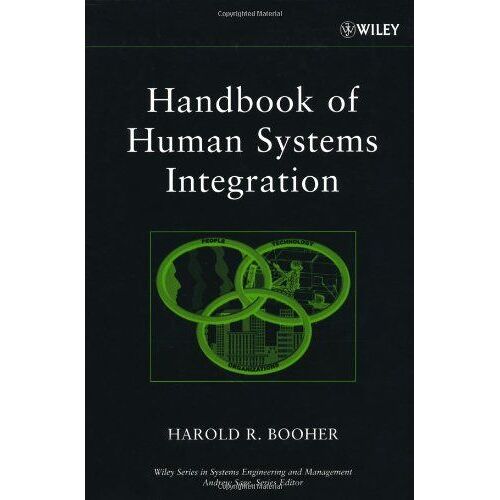
Handbook of Human Systems Integration - Booher, Harold R
- Format: Relié Voir le descriptif
Vous en avez un à vendre ?
Vendez-le-vôtreSoyez informé(e) par e-mail dès l'arrivée de cet article
Créer une alerte prix
- Payez directement sur Rakuten (CB, PayPal, 4xCB...)
- Récupérez le produit directement chez le vendeur
- Rakuten vous rembourse en cas de problème

Gratuit et sans engagement
Félicitations !
Nous sommes heureux de vous compter parmi nos membres du Club Rakuten !
TROUVER UN MAGASIN
Retour
Avis sur Handbook Of Human Systems Integration de Booher, Harold R Format Relié - Livre Physique - Chimie
0 avis sur Handbook Of Human Systems Integration de Booher, Harold R Format Relié - Livre Physique - Chimie
Les avis publiés font l'objet d'un contrôle automatisé de Rakuten.
Présentation Handbook Of Human Systems Integration de Booher, Harold R Format Relié
- Livre Physique - Chimie


Résumé : Foreword xiii Preface xv Contributors xix Technical Advisors and Reviewers xxv Chapter 1. Introduction: Human Systems Integration 1 1.1 Background 1 1.2 HSI Concept 4 1.3 Sociotechnical Systems Complexity 9 1.4 HSI Unique Aspects 11 1.5 Ten HSI Principles 12 1.6 HSI Principles Applied to Systems Acquisition 18 1.7 HSI Organizational Maturity 21 1.8 Discussion and Summary 23 1.9 Book Overview 27 Part 1 Organization, Management, and Culture 31 Chapter 2. Leadership That Achieves Human Systems Integration 33 2.1 Introduction: Beyond Reductionism 33 2.2 Importance of Culture 34 2.3 Leadership Matters 37 2.4 Transformational Change Model 39 2.5 Phase 1: Decide to Change 39 2.6 Phase 2: Guide Change 45 2.7 Phase 3: Support Change 49 2.8 Phase 4: Sustain Change 54 2.9 Overcoming Challenges to Change 58 2.10 Conclusion 59 Chapter 3. Human Systems Integration Roles in a Systems Acquisition Culture 63 3.1 Introduction 63 3.2 Common Cultural Influences 66 3.3 Historical Perspective of Culture 73 3.4 Changing Acquisition Culture 80 3.5 Trends for the Future of HSI 85 3.6 HSI Cultural Myths versus Realities 86 3.7 Roles and Responsibilities 90 3.8 Summary and Conclusions 90 Appendix: HSI Roles and Responsibilities 92 Chapter 4. Human Systems Integration and Systems Acquisition Interfaces 101 4.1 Introduction 101 4.2 Systems Acquisition Processes 102 4.3 Presystems Acquisition 108 4.4 Systems Acquisition 112 4.5 Sustainment 117 4.6 Conclusion 117 Chapter 5. Human Systems Integration Education and Training 121 5.1 Introduction 121 5.2 HSI Competencies Needed 122 5.3 Academic Education 126 5.4 Textbooks 140 5.5 HSI Training Courses 147 5.6 HSI Careers 149 5.7 HSI Professional Personnel Supply 157 5.8 Summary and Conclusions 160 Part II Systems Acquisition and Management Processes 165 Chapter 6. Human Systems Integration Requirements in Systems Acquisition 167 6.1 Introduction 167 6.2 Human Systems Integration in Requirements 169 6.3 Human Systems Integration Requirements Issues 177 6.4 United Kingdom HFI Process 189 6.5 Summary and Conclusions 198 Chapter 7. Human Systems Integration and Acquisition: Contractor's Perspective 201 7.1 Introduction 201 7.2 Stages of Procurement Activity 202 7.3 Principal Documentation Events of Acquisition 219 7.4 HSI Program Management Guidelines 225 7.5 Summary 230 Chapter 8. Human System Measurements and Trade-offs in System Design 233 8.1 Introduction 233 8.2 Human System Measurement 233 8.3 General Measurement Model for HSI 238 8.4 Analytical and Modeling Techniques Early in Design Process 244 8.5 Human Performance Experimentation 246 8.6 Modeling and Simulation 248 8.7 Interactions among HSI Domains 253 8.8 Future Trends 258 8.9 Summary and Conclusion 259 Chapter 9. Simulation-Based Acquisition 265 9.1 Introductio...
Harold R. Booher
Charles S. Harris
Betty K. Hart
Joyce Shields
Glen Hewitt
Dino Piccione
Edwin R. Smootz
Brian M. Kleiner
Harold R. Booher
John A. Harrison
Melanie J. Forster
Bruce E. Hamilton
Michael Barnes
David Beevis
Stephen R. Olson
Andrew P. Sage
Biographie:
HAROLD R. BOOHER, PhD, is a consultant on human systems integration and MANPRINT applications to systems design, development, and assessment. Dr. Booher was the first Senior Executive (SES) Director of MANPRINT for the Department of the Army and is Editor of MANPRINT: An Approach to Systems Intergration. He has more than thirty-five years? experience in human factors and engineering in government, industry, and academic applications, and is a Fellow of the Human Factors and Ergonomics Society....
Sommaire:
A groundbreaking look at how technology with a human touch is revolutionizing government and industry
Human Systems Integration (HSI) is very attractive as a new integrating discipline designed to help move business and engineering cultures toward a more people-technology orientation. Over the past decade, the United States and foreign governments have developed a wide range of tools, techniques, and technologies aimed at integrating human factors into engineering systems in order to achieve important cost and performance benefits that otherwise would not have been accomplished. In order for this new discipline to be effective, however, a cultural change is needed that must start with organizational leadership.
Handbook of Human Systems Integration outlines the principles and methods that can be used to help integrate people, technology, and organizations with a common objective toward designing, developing, and operating systems effectively and efficiently. Handbook of Human Systems Integration is broad in scope, covering both public and commercial processes as they interface with systems engineering processes. Emphasizing the importance of management and organization concepts as well as the technical uniqueness of HSI, Handbook of Human Systems Integration features:
* More than ninety contributors, technical advisors, and reviewers from government, industry, and academia
* Comprehensive coverage of the most recent HSI developments, particularly in presenting the cutting-edge tools, techniques, and methodologies utilized by each of the HSI domains
* Chapters representing the governments and industries of the United Kingdom and Canada
* Contributions from three services of the Department of Defense along with the Federal Aviation Administration and the National Academy of Sciences
* Many chapters covering both military and nonmilitary applications
* Concepts widely used by government contractors both in the United States and abroad
This book will be of special interest to HSI practitioners, systems engineers, and managers, as well as government and industry decision-makers who must weigh the recommendations of all multidisciplines contributing to systems performance, safety, and costs in order to make sound systems acquisition decisions....