
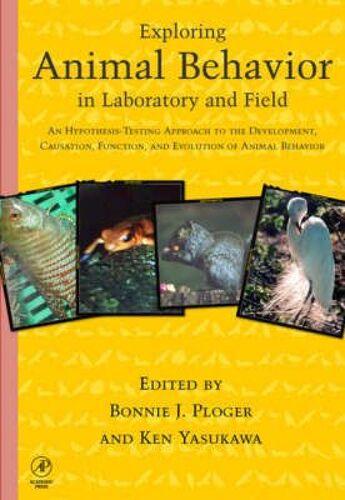
Exploring Animal Behavior In Laboratory And Field: An Hypothesis-Testing Approach To The Development, Causation, Function, And Evolution Of Animal Behavior - Bonnie J. Ploger
- Format: Non Precisé Voir le descriptif
Vous en avez un à vendre ?
Vendez-le-vôtreExpédition rapide et soignée depuis l`Angleterre - Délai de livraison: entre 10 et 20 jours ouvrés.

- Payez directement sur Rakuten (CB, PayPal, 4xCB...)
- Récupérez le produit directement chez le vendeur
- Rakuten vous rembourse en cas de problème

Gratuit et sans engagement
Félicitations !
Nous sommes heureux de vous compter parmi nos membres du Club Rakuten !
TROUVER UN MAGASIN
Retour
Avis sur Exploring Animal Behavior In Laboratory And Field: An Hypothesis - Testing Approach To The Development, Causation... - Livre
0 avis sur Exploring Animal Behavior In Laboratory And Field: An Hypothesis - Testing Approach To The Development, Causation... - Livre
Les avis publiés font l'objet d'un contrôle automatisé de Rakuten.
Présentation Exploring Animal Behavior In Laboratory And Field: An Hypothesis - Testing Approach To The Development, Causation...
- Livre
Résumé :
Exploring Animal Behavior in Laboratory and Field is designed to provide a variety of exercises that engage students actively in all phases of scientific investigation, from formulating research questions through interpreting and presenting final results. It attempts to share the collective teaching expertise and experience of members of the Animal Behavior Society with all who are willing to benefit from their wisdom. Four types of exercises are presented: (1) traditional exercises in which students follow a pre-determined protocol to test particular hypotheses explicitly stated in the exercise, (2) traditional exercises that can easily be adapted to inquiry-based approaches, (3) combined pedagogy exercises that involve both traditional and inquiry approaches, and (4) inquiry exercises in which students first brainstorm to generate their own hypotheses, then design their own experiements to test their hypotheses....
Sommaire:
CONTRIBUTORS
PREFACE
PART 1. INTRODUCTION
PART 2. DESCRIBING BEHAVIOR
1. Learning to describe and quantify animal behavior
B.J. Ploger
2. Developing operational definitions and measuring interobserver reliability using house crickets (Acheta domesticus)
T. Glover
PART 3. CAUSATION
3. Courtship, mating, and sex pheromones in the mealworm beetle, Tenebrio molitor
E. Font and E. Desfilis
4. Courtship and mate attraction in parasitic wasps
R.W. Matthews and J.R. Matthews
5. Chemoreception in lizards
C. O'Neil Krekorian
6. Behavioral thermoregulation in field populations of amphibian larvae
H.H. Whiteman and N. Buschhaus
7. Temperature dependence of the electric organ discharge in weakly electric fish
G.K.H. Zupanc, J.R. Banks, G. Engler and R.C. Beason
8. Observing and analyzing human nonverbal communication
P.L. Bernstein
9. Foraging behavior of ants, or picnics: an ant's eye view
S.L. Halkin
10. Hummingbird foraging patterns: experiments using artificial flowers
A. Inman
11. Honey bee foraging behavior
M.R. Richter and J.M. Keramaty
12. Individual constancy to color by foraging honeybees
P.S.M. Hill and H. Wells
PART 4. DEVELOPMENT
13. Dog training laboratory: applied animal behavior
L.L. Gillie and G.H. Waring
14. Paternal care and its effect on maternal behavior and pup survival and development in prairie voles (Microtus ochrogaster)
B. McGuire
15. The effect of prenatal visual stimulation on the imprinting responses of domestic chicks: an examination of sensitive periods during development
W.L. Hill
16. Development of thermoregulation in altricial rodents
G.R. Michener and T.D. Charge
17. Aggregation and kin recognition in African clawed frogs, Xenopus laevis
K.L. Anderson and B.J. Ploger
PART 5. ADAPTATION AND EVOLUTION
Section I: Foraging
18. Diving birds: a field study of benthic and piscivorous foragers
J.J. Templeton & D.J. Mountjoy
19. Found a peanut: foraging decisions by squirrels
S.L. Halkin
20. Economic decisions and foraging tradeoffs in chickadees
R.L. Mumme
21. Seed selection by foraging birds
M.R. Richter, J.A. Halstead and K. Savastano
22. Competitive behavior of birds at feeders
A. Mostrom
Section II: Avoiding Predators
23. Vigilance and the group-size effect: observing behavior in humans
J.E. Scheib, L.E. Cody, N.S. Clayton and R.D. Montgomerie
24. The function of chat calls in northern mockingbirds (Mimus polyglottos): vocal defense of nestlings
C.A. Logan
25. Diving and skating in whirligig beetles: alternative antipredator responses
A. Inman and A. Houtman
26. The response of tree squirrels to conspecific and heterospecific alarm calls
A. Houtman
Section III: Agonistic Behavior
27. Competition for breeding resources by burying beetles
M.P. Scott
28. Learning to be winners and losers: agonistic behavior in crayfish
E.M. Jakkob and C.D. Hoefler
Section IV: Courtship and Parental Care
29. Costs and benefits of maternal care in earwigs
R.L. Mumme, J.O. Palmer and S.M. Ranking
30. Vocal behavior and mating tactics of the spring peeper (Pseudacris crucifer): a field exercise in animal behavior
D.C. Forester
31. The role of multiple male characters in mate choice by female guppies (Poecilia reticulata)
D.J. Albrecht
32. Investigating human m...
Détails de conformité du produit
Personne responsable dans l'UE