
154,79 €
Produit Neuf
Ou 38,70 € /mois
- Livraison : 3,99 €
- Livré entre le 25 et le 31 juillet
Nos autres offres
-
162,10 €
Produit Neuf
Ou 40,53 € /mois
- Livraison à 0,01 €
- Livré entre le 27 juillet et le 8 août
Brand new, In English, Fast shipping from London, UK; Tout neuf, en anglais, expédition rapide depuis Londres, Royaume-Uni;ria9783030353063_dbm
Voir le détail de l'annonce

- Payez directement sur Rakuten (CB, PayPal, 4xCB...)
- Récupérez le produit directement chez le vendeur
- Rakuten vous rembourse en cas de problème

Gratuit et sans engagement
Félicitations !
Nous sommes heureux de vous compter parmi nos membres du Club Rakuten !
TROUVER UN MAGASIN
Retour
Avis sur Active Cognition de Format Broché - Livre Philosophie
0 avis sur Active Cognition de Format Broché - Livre Philosophie
Les avis publiés font l'objet d'un contrôle automatisé de Rakuten.
-
Just Enough Software Architecture: A Risk-Driven Approach
Occasion dès 135,99 €
-
St - Tropez Soleil
1 avis
Neuf dès 105,00 €
-
The Mirabelle Cookbook
Occasion dès 94,71 €
-
Dji Osmo 4 : 4k/240fps3activetrack
Neuf dès 85,99 €
-
Gilbert Portanier
Neuf dès 141,34 €
-
Vouet: Grand Palais 6 Novembre 1990 11 Février 1991
Occasion dès 150,00 €
-
Pete Townshend: Who I Am
Neuf dès 127,99 €
-
Cambridge English Proficiency 2 Student's Book With Answers With Audio
Neuf dès 91,64 €
-
Georgia O'keeffe
Occasion dès 106,99 €
-
A First Course In Logic
Neuf dès 130,46 €
Occasion dès 163,99 €
-
Car Racing 1965
2 avis
Neuf dès 109,00 €
-
The Lord Of The Rings
Neuf dès 183,44 €
-
The New Munsell Student Color Set
Neuf dès 125,62 €
-
Mykonos Muse
Neuf dès 105,00 €
Occasion dès 155,00 €
-
Jouef : Les Petits Trains De Notre Enfance
1 avis
Occasion dès 115,00 €
-
Paolo Roversi Livre Nudi
2 avis
Occasion dès 175,00 €
-
Car Racing 1970
3 avis
Neuf dès 129,00 €
-
Financial & Managerial Accounting Ise
Neuf dès 104,72 €
-
Official Game Guide Mass Effect 3 Collector Edition
Occasion dès 79,00 €
-
Oxford Resources For Ib Dp Chemistry: Course Book
Neuf dès 102,33 €
Produits similaires
Présentation Active Cognition de Format Broché
- Livre Philosophie


Résumé :
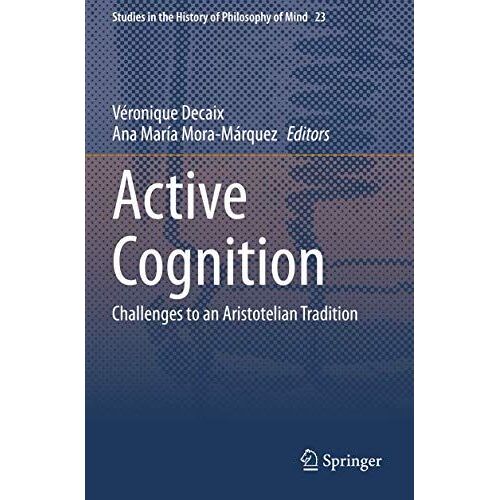
This edited work draws on a range of contributed expertise to trace the fortune of an Aristotelian thesis over different periods in the history of philosophy. It presents eight cases of direct or indirect challenges to the Aristotelian passive account of human cognition, taking the reader from late antiquity to the 20th century. Chapters analyse the (often indirect) effect of Aristotle?s account of cognition on later periods. In his influential De anima, Aristotle describes human cognition, both sensitive and intellectual, as the reception of a form in the cognitive subject. Aristotle?s account has been commonly interpreted as fundamentally passive ? the cognitive subject is a passive actor upon which a cognitive process is acted by the object. However, at least from the time of Alexander of Aphrodisias onwards, this interpretationhas been challenged by authors who posit a fundamental active aspect of cognition. Readers will discover how one or more of three concerns ? ontological superiority, direct realism and moral responsibility ? drive the active accounts of cognition. Contributed chapters from top scholars examine how these three concerns lead thinkers to take issue with the idea that cognition is a passive process. The authors consider Jesuit accounts of cognition, Malebranche on judgment, and Wittgenstein on perception, as well as Stumpf on active cognition, among other relevant works. This book is ideally suited to scholars of philosophy, especially those with an interest in medieval epistemology, the influence of Aristotle, philosophy of mind and theories of cognition.
Biographie: V?ronique Decaix is Associate Professor in Medieval Philosophy at University Paris 1 Panth?on-Sorbonne. Her research interests are psychology, theories of cognition and metaphysics. In the framework of GRAMATA, UMR 7219 (Groupe Antiquit?, Moyen ?ge, Transmission Arabe) she is currently leading the research project Memoria on Ancient and Medieval Theories of Memory).
Sommaire:
This edited work draws on a range of contributed expertise to trace the fortune of an Aristotelian thesis over different periods in the history of philosophy. It presents eight cases of direct or indirect challenges to the Aristotelian passive account of human cognition, taking the reader from late antiquity to the 20th century. Chapters analyse the (often indirect) effect of Aristotle's account of cognition on later periods. In his influential De anima, Aristotle describes human cognition, both sensitive and intellectual, as the reception of a form in the cognitive subject. Aristotle's account has been commonly interpreted as fundamentally passive - the cognitive subject is a passive actor upon which a cognitive process is acted by the object. However, at least from the time of Alexander of Aphrodisias onwards, this interpretationhas been challenged by authors who posit a fundamental active aspect of cognition. Readers will discover how one or more of three concerns - ontological superiority, direct realism and moral responsibility - drive the active accounts of cognition. Contributed chapters from top scholars examine how these three concerns lead thinkers to take issue with the idea that cognition is a passive process. The authors consider Jesuit accounts of cognition, Malebranche on judgment, and Wittgenstein on perception, as well as Stumpf on active cognition, among other relevant works. This book is ideally suited to scholars of philosophy, especially those with an interest in medieval epistemology, the influence of Aristotle, philosophy of mind and theories of cognition....
Détails de conformité du produit
Personne responsable dans l'UE