
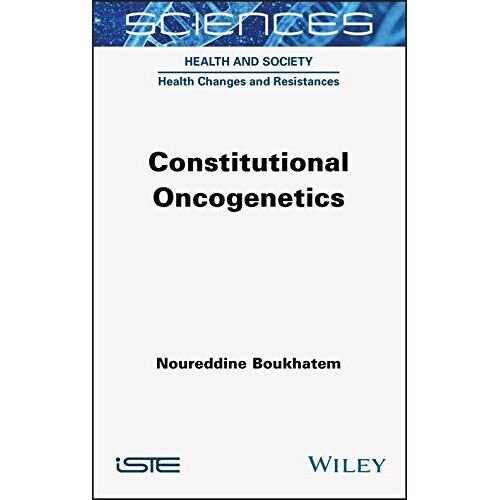
Constitutional Oncogenetics - Boukhatem, Noureddine
- Format: Relié Voir le descriptif
Vous en avez un à vendre ?
Vendez-le-vôtre213,10 €
Produit Neuf
Ou 53,28 € /mois
- Livraison à 0,01 €
- Livré entre le 28 juillet et le 10 août
Brand new, In English, Fast shipping from London, UK; Tout neuf, en anglais, expédition rapide depuis Londres, Royaume-Uni;ria9781789450163_dbm

- Payez directement sur Rakuten (CB, PayPal, 4xCB...)
- Récupérez le produit directement chez le vendeur
- Rakuten vous rembourse en cas de problème

Gratuit et sans engagement
Félicitations !
Nous sommes heureux de vous compter parmi nos membres du Club Rakuten !
TROUVER UN MAGASIN
Retour
Avis sur Constitutional Oncogenetics Format Relié - Livre
0 avis sur Constitutional Oncogenetics Format Relié - Livre
Les avis publiés font l'objet d'un contrôle automatisé de Rakuten.
Présentation Constitutional Oncogenetics Format Relié
- Livre


Résumé : Foreword xvii Introduction xix Part 1. Major Syndromes 1 Chapter 1. Hereditary Breast and Ovarian Cancer Syndrome Including Isolated Ovarian Cancers 3 1.1. Introduction 3 1.2. Prevalence 4 1.2.1. Genetic risk assessment criteria 5 1.3. Indications for genetic testing 8 1.4. Tumors 8 1.4.1. Breast 8 1.4.2. Ovaries 10 1.5. Genes 12 1.5.1. BRCA1 12 1.5.2. BRCA2 12 1.5.3. CHEK2 12 1.5.4. PALB2 13 1.5.5. NBN 13 1.5.6. BARD1 13 1.5.7. BRIP1 13 1.5.8. RAD51C 14 1.5.9. RAD51D 14 1.6. Genotype-phenotype correlations 14 1.7. Penetrance 15 1.8. Mode of transmission 17 1.9. Risks to family members: special consideration 17 1.10. Monitoring 18 1.10.1. Women 18 1.10.2. Men 20 1.10.3. Men and women 20 1.10.4. Risks to relatives 20 1.10.5. Reproductive options 21 Chapter 2. Lynch Syndrome 25 2.1. Introduction 25 2.2. Prevalence 27 2.3. Genes 28 2.4. Genotype-phenotype correlations 28 2.5. Penetrance and survival 29 2.6. Long-term prevalence of cancer in LS patients 30 2.7. Mode of transmission 33 2.8. When to suspect LS 33 2.8.1. Amsterdam II criteria 33 2.8.2. Criteria to help identify families with LS 33 2.8.3. Revised Bethesda criteria 34 2.8.4. Spectra and syndromes 34 2.9. Tumors 35 2.9.1. Colorectal cancer 35 2.9.2. Endometrial cancer 36 2.9.3. Bladder and urothelial tract 36 2.9.4. Dermatological tumors 37 2.9.5. Pancreatic tumors 38 2.9.6. Tumors of the ovary 38 2.9.7. Brain tumors 38 2.10. Monitoring 39 2.10.1. Colorectal cancer risks 39 2.10.2. GC risks 40 2.10.3. Risks of endometrial and ovarian cancer 40 2.10.4. Risks to the bladder and urothelial tract 41 2.10.5. Risks of dermatological tumors 42 2.10.6. Risks for other types of cancer 42 Chapter 3. Neurofibromatosis 43 3.1. Introduction 43 3.2. Neurofibromatosis type 1 43 3.2.1. Introduction 43 3.2.2. Prevalence 43 3.2.3. When to suspect NF1 44 3.2.4. Tumors 44 3.2.5. Gene 45 3.2.6. Genotype-phenotype correlations 46 3.2.7. Penetrance 46 3.2.8. Mode of transmission 47 3.2.9. Monitoring 48 3.3. Neurofibromatosis type 2 49 3.3.1. Introduction 49 3.3.2. Prevalence 51 3.3.3. When to suspect NF2 51 3.3.4. Tumors 51 3.3.5. Gene 52 3.3.6. Genotype-phenotype correlations 52 3.3.7. Penetrance 53 3.3.8. Mode of transmission 53 3.3.9. Risks to family members 53 3.3.10. Monitoring 54 3.4. Schwannomatosis 55 3.4.1. Introduction 55 3.4.2. Prevalence 55 3.4.3. When to suspect schwannomatosis 55 3.4.4. Tumors 55 3.4.5. Genes 56 3.4.6. Genotype-phenotype correlations 57 3.4.7. Penetrance 57 3.4.8. Mode of transmission 57 3.4.9. Monitoring 58 Chapter 4. Familial Adenomatous Polyposis 59 4.1. Introduction 59 4.1.1. FAP 59 4.1.2. AFAP 60 4.1.3. MAP 60 4.1.4. NAP 60 4.1.5. PPAP 60 4.2. Prevalence 61 4.2.1. FAP 61 4.2.2. MAP 61 4.2.3. NAP 62 4.2.4. PPAP 62 4.3. When to suspect FAP 63 4.4. Tumors 63 4.4.1. FAP 63 4.4.2. MAP 64 4.4.3. NAP 65 4.4.4. PPAP 65 4.5. Genes 65 4.5.1. APC 65 4.5.2. MUTYH 66 4.5.3. NTHL1 66 4.5.4. POLE and POLD1 66 4.6. ...
Biographie: Noureddine Boukhatem is a professor at Mohamed I University, in Morocco, where he leads the Genetics and Immune Therapy team. He has also worked on the oncogenetic services of the Curie and Gustave Roussy Institute and the Jean Perrin Centre, in France....
Sommaire: Constitutional Oncogenetics gives precise descriptions of the main syndromes that cause a predisposition for cancer. The first part examines the most common syndromes in the majority of the world, including the heightened hereditary risk of breast and ovarian cancer and Lynch syndrome. The second part introduces less common infracentesimal syndromes, such as Bloom syndrome and Fanconi syndrome. This book is intended for oncogenetic practitioners and other specialists, as well as medical students....
In the age of genomics, oncogenetics is a growing discipline. It is defined as the identification and management of families where there is a suspected hereditary risk of cancer. This relatively new discipline is part of a modern medicine that aims to be both preventive and predictive.
Détails de conformité du produit
Personne responsable dans l'UE