
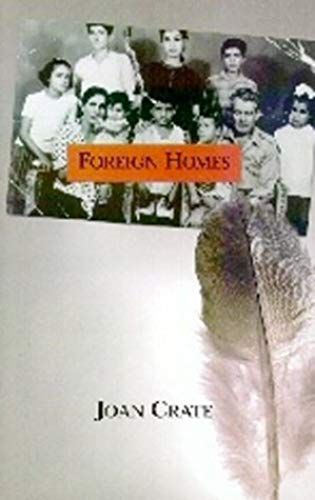
Foreign Homes - Joan Crate
- Format: Poche Voir le descriptif
Vous en avez un à vendre ?
Vendez-le-vôtreSoyez informé(e) par e-mail dès l'arrivée de cet article
Créer une alerte prix
- Payez directement sur Rakuten (CB, PayPal, 4xCB...)
- Récupérez le produit directement chez le vendeur
- Rakuten vous rembourse en cas de problème

Gratuit et sans engagement
Félicitations !
Nous sommes heureux de vous compter parmi nos membres du Club Rakuten !
TROUVER UN MAGASIN
Retour
Avis sur Foreign Homes Format Poche - Livre Littérature étrangère
0 avis sur Foreign Homes Format Poche - Livre Littérature étrangère
Les avis publiés font l'objet d'un contrôle automatisé de Rakuten.
Présentation Foreign Homes Format Poche
- Livre Littérature étrangère


Résumé : Foreign Homes, Joan Crate's second book of poems, explores domesticity and dislocation, where what was thought to be home becomes alien, and where the alien is, piece by piece, made into home -- often in such simple, physical acts as laying a table, or driving a highway, or reassembling a tom photograph. In Crate's careful hands, the knife that cuts the vegetables for dinner can transform the blade-edge of a distant war. Her migratory poems slip from voice to voice, from love to landscape to language, present to past, exile to return, illuminating the boundary that is also a border crossing between one person, one place, and another: We have crossed borders to reach --from Dowries Domestic images and personal narrative surround a burning, incantatory sequence at the centre of the book, where poems circle Shawnandithit, a Beothuk who died in exile in Newfoundland in the nineteenth century, the last of her people. In giving voice to what is unknown, feared, lost, and silent, Crate's playful language is itself powerfully involved in this act-often violent-of breaking and making anew. And whether these homes are stolen or lost or stumblingly found, Crate is unflinching even as her own homes are made and un-made, watching those who wait on the porch steps/ eager to move into our youth, / to reassemble our bones.
each other and lost land
chafes our touch. I carry
snowshoes, winter wheat, raven call, winter pocked by arsenic flakes from the mines.
You bring donkey sweat and spent bullets,
voices that shriek out, tear bright.
We offer them to each other-
gift and sacrifice.
Biographie: Joan Crate was born in Yellowknife, Northwest Territories. Her numerous publications include poetry and short stories in Grain, Secrets from the Orange Couch, blue buffalo, and the Calgary Herald.
Sommaire: Foreign Homes, Joan Crate's second book of poems, explores domesticity and dislocation, where what was thought to be home becomes alien, and where the alien is, piece by piece, made into home -- often in such simple, physical acts as laying a table, or driving a highway, or reassembling a tom photograph. In Crate's careful hands, the knife that cuts the vegetables for dinner can transform the blade-edge of a distant war. Her migratory poems slip from voice to voice, from love to landscape to language, present to past, exile to return, illuminating the boundary that is also a border crossing between one person, one place, and another: We have crossed borders to reach -from Dowries Domestic images and personal narrative surround a burning, incantatory sequence at the centre of the book, where poems circle Shawnandithit, a Beothuk who died in exile in Newfoundland in the nineteenth century, the last of her people. In giving voice to what is unknown, feared, lost, and silent, Crate's playful language is itself powerfully involved in this act-often violent-of breaking and making anew. And whether these homes are stolen or lost or stumblingly found, Crate is unflinching even as her own homes are made and un-made, watching those who wait on the porch steps/ eager to move into our youth,/ to reassemble our bones.
each other and lost land
chafes our touch. I carry
snowshoes, winter wheat, raven call, winter pocked by arsenic flakes from the mines.
You bring donkey sweat and spent bullets,
voices that shriek out, tear bright.
We offer them to each other-
gift and sacrifice.