
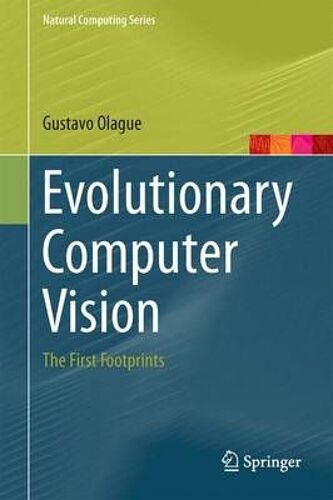
Evolutionary Computer Vision - Olague, Gustavo
- Format: Relié Voir le descriptif
Vous en avez un à vendre ?
Vendez-le-vôtre89,73 €
Produit Neuf
Ou 22,43 € /mois
- Livraison à 0,01 €
- Livré entre le 29 juillet et le 10 août
Brand new, In English, Fast shipping from London, UK; Tout neuf, en anglais, expédition rapide depuis Londres, Royaume-Uni;ria9783662436929_dbm
Nos autres offres
-
87,19 €
Produit Neuf
Ou 21,80 € /mois
- Livraison : 3,99 €
- Livré entre le 28 juillet et le 3 août
Voir le détail de l'annonce

- Payez directement sur Rakuten (CB, PayPal, 4xCB...)
- Récupérez le produit directement chez le vendeur
- Rakuten vous rembourse en cas de problème

Gratuit et sans engagement
Félicitations !
Nous sommes heureux de vous compter parmi nos membres du Club Rakuten !
TROUVER UN MAGASIN
Retour
Avis sur Evolutionary Computer Vision Format Relié - Livre Beaux arts
0 avis sur Evolutionary Computer Vision Format Relié - Livre Beaux arts
Les avis publiés font l'objet d'un contrôle automatisé de Rakuten.
-
Die Luzerner Chronik Des Diebold Schilling, Aus Dem Jahre 1513
Occasion dès 49,50 €
-
By Marc Pairon Art Deco Ceramics Made In Belgium: Charles Catteau
6 avis
Occasion dès 110,00 €
-
The Shock Of The Ancient
Neuf dès 79,73 €
-
An American Odyssey - Photos From The Detroit Photographic Compagny 1888-1924
Occasion dès 114,00 €
-
Collection Entremets & Petits Gâteaux
1 avis
Occasion dès 49,89 €
-
Poetry In Stitches - Clothes You Can Knit
Occasion dès 50,00 €
-
Monster Hunter: World - Official Complete Works
1 avis
Neuf dès 58,42 €
-
Environmental Psychology
Neuf dès 66,26 €
-
Les Trains Blindes: De 1825 À Nos Jours
2 avis
Neuf dès 64,00 €
-
Cambridge English Skills Real Listening And Speaking 1 With Answers And Audio Cd
1 avis
Occasion dès 48,07 €
-
Refocus: The Films Of Doris Wishman
Neuf dès 46,03 €
-
Saab 95 & 96 Petrol (66 - 76) Haynes Repair Manual
Neuf dès 48,46 €
-
Indian Jewelry Making Volume 1
Occasion dès 110,00 €
-
Project Management For Engineers
Neuf dès 69,48 €
-
Cambridge English Movers 1 For Revised Exam From 2018 Audio Cds (2)
Neuf dès 49,90 €
-
Ann Lowe
Neuf dès 67,09 €
-
Les Plantes Tropicales À Épices
Occasion dès 57,01 €
-
The Wine Trade In Medieval Europe 1000-1500
Neuf dès 79,17 €
-
Argentina Ruta 40
Occasion dès 99,00 €
-
A Practical Guide To Macroeconomics
Neuf dès 45,95 €
Produits similaires
Présentation Evolutionary Computer Vision Format Relié
- Livre Beaux arts


Résumé :
This book explains the theory and application of evolutionary computer vision, a new paradigm where challenging vision problems can be approached using the techniques of evolutionary computing. This methodology achieves excellent results for defining fitness functions and representations for problems by merging evolutionary computation with mathematical optimization to produce automatic creation of emerging visual behaviors. In the first part of the book the author surveys the literature in concise form, defines the relevant terminology, and offers historical and philosophical motivations for the key research problems in the field. For researchers from the computer vision community, he offers a simple introduction to the evolutionary computing paradigm. The second part of the book focuses on implementing evolutionary algorithms that solve given problems using working programs in the major fields of low-, intermediate- and high-level computer vision. This book will be ofvalue to researchers, engineers, and students in the fields of computer vision, evolutionary computing, robotics, biologically inspired mechatronics, electronics engineering, control, and artificial intelligence.
Biographie:
Gustavo Olague received his Ph.D. in Computer Vision, Graphics and Robotics from INPG (Institut Polytechnique de Grenoble) and INRIA (Institut National de Recherche en Informatique et Automatique) in France. He is a Professor in the Dept. of Computer Science at CICESE (Centro de Investigaci?n Cient?fica y de Educaci?n Superior de Ensenada) in Mexico, and the Director of its EvoVisi?n Research Team. He is also an Adjoint Professor of Engineering at UACH (Universidad Auton?ma de Chihuahua). He has authored over 100 conference proceedings papers and journal articles, he coedited two special issues in Pattern Recognition Letters and Evolutionary Computation, and he served as cochair of the Real-World Applications track at the main international evolutionary computing conference, GECCO (ACM SIGEVO Genetic and Evolutionary Computation Conference). Prof. Olague has received numerous distinctions, among them the Talbert Abrams Award presented by the American Society for Photogrammetry and Remote Sensing (ASPRS) for?authorship and recording of current and historical engineering and scientific developments in photogrammetry...
Sommaire: Introduction.- Vision and Evolution: The State of the Art.- Evolutionary Computing.- Accurate Modeling of Image Features Using Evolutionary Computing.- Evolutionary Synthesis of Interest Point Detectors Through Genetic Programming.- The Honeybee Search Algorithm.- Multiobjective Sensor Planning for Accurate Reconstruction.- Evolutionary Visual Learning with Linear Genetic Programming.- Evolutionary Synthesis of Feature Descriptor Operators with Genetic Programming.- Summary and Conclusions.- App. A, Camera Calibration and Stereoscopic Vision.- Glossary.- Index.
Détails de conformité du produit
Personne responsable dans l'UE