
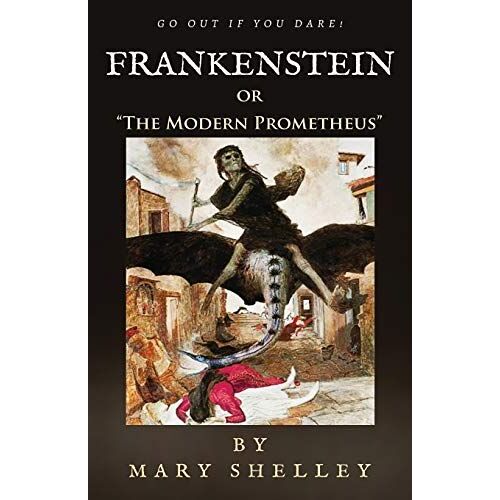
Frankenstein: or The Modern Prometheus - Mary Shelley
- Format: Broché Voir le descriptif
Vous en avez un à vendre ?
Vendez-le-vôtreSoyez informé(e) par e-mail dès l'arrivée de cet article
Créer une alerte prix
- Payez directement sur Rakuten (CB, PayPal, 4xCB...)
- Récupérez le produit directement chez le vendeur
- Rakuten vous rembourse en cas de problème

Gratuit et sans engagement
Félicitations !
Nous sommes heureux de vous compter parmi nos membres du Club Rakuten !
TROUVER UN MAGASIN
Retour
Avis sur Frankenstein: Or The Modern Prometheus Format Broché - Livre Science-fiction
0 avis sur Frankenstein: Or The Modern Prometheus Format Broché - Livre Science-fiction
Les avis publiés font l'objet d'un contrôle automatisé de Rakuten.
Présentation Frankenstein: Or The Modern Prometheus Format Broché
- Livre Science-fiction


Résumé :
Generally known as Frankenstein, is a novel written by the British author Mary Shelley. The title of the novel refers to a scientist, Victor Frankenstein, who learns how to create life and creates a being in the likeness of man, but larger than average and more powerful. In popular culture, people have tended to refer to the Creature as Frankenstein, despite this being the name of the scientist. Frankenstein is a novel infused with some elements of the Gothic novel and the Romantic movement. It was also a warning against the over-reaching of modern man and the Industrial Revolution, alluded to in the novel's subtitle, The Modern Prometheus. The story has had an influence across literature and popular culture and spawned a complete genre of horror stories and films. It is arguably considered the first fully realized science fiction novel. Shelley travelled through Europe in 1815 along the river Rhine in Germany stopping in Gernsheim, 17 kilometres (11 mil) away from Frankenstein Castle, where two centuries before, an alchemist engaged in experiments. She then journeyed to the region of Geneva, Switzerland, where much of the story takes place. The topic of galvanism and occult ideas were themes of conversation among her companions, particularly her lover and future husband Percy B. Shelley. Mary, Percy and Lord Byron had a competition to see who could write the best horror story. After thinking for days, Shelley dreamt about a scientist who created life and was horrified by what he had made, inspiring the novel. Since the publication of the novel, the name Frankenstein has often been used to refer to the monster itself. In the novel, Frankenstein's creation is identified by words such as creature, monster, daemon, wretch, abortion, fiend and it. Speaking to Victor Frankenstein, the monster says I ought to be thy Adam, but I am rather the fallen angel (which ties to Lucifer in Paradise Lost, which the monster reads, and which relates to the disobedience of Prometheus in the book's subtitle).
Biographie:
English writer Mary Shelley (1797-1851) is best known for her horror novel Frankenstein, or the Modern Prometheus. She was married to poet Percy Bysshe Shelley.
Who Was Mary Shelley?
Writer Mary Shelley published her most famous novel, Frankenstein, in 1818. She wrote several other books, including Valperga (1823), The Last Man (1826), the autobiographical Lodore (1835) and the posthumously published Mathilde.
Early Life:
Shelley was born Mary Wollstonecraft Godwin on August 30, 1797, in London, England. She was the daughter of philosopher and political writer William Godwin and famed feminist Mary Wollstonecraft - the author of The Vindication of the Rights of Woman (1792). Sadly for Shelley, she never really knew her mother who died shortly after her birth. Her father William Godwin was left to care for Shelley and her older half-sister Fanny Imlay. Imlay was Wollstonecraft's daughter from an affair she had with a soldier.
The family dynamics soon changed with Godwin's marriage to Mary Jane Clairmont in 1801. Clairmont brought her own two children into the union, and she and Godwin later had a son together. Shelley never got along with her stepmother. Her stepmother decided that her stepsister Jane (later Claire) should be sent away to school, but she saw no need to educate Shelley.