
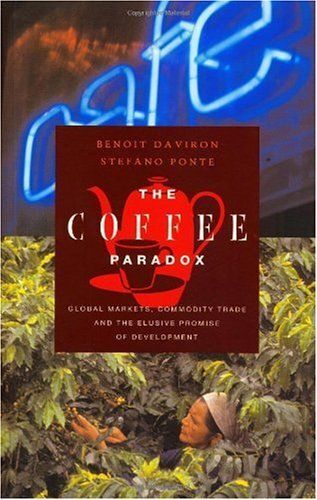
The Coffee Paradox - Daviron, Benoit
- Format: Broché Voir le descriptif
Vous en avez un à vendre ?
Vendez-le-vôtreExpédition rapide et soignée depuis l`Angleterre - Délai de livraison: entre 10 et 20 jours ouvrés.
Nos autres offres
-
58,67 €
Produit Neuf
Ou 14,67 € /mois
- Livraison à 0,01 €
- Livré entre le 26 mai et le 2 juin
Brand new, In English, Fast shipping from London, UK; Tout neuf, en anglais, expédition rapide depuis Londres, Royaume-Uni;ria9781842774571_dbm
Voir le détail de l'annonce

- Payez directement sur Rakuten (CB, PayPal, 4xCB...)
- Récupérez le produit directement chez le vendeur
- Rakuten vous rembourse en cas de problème

Gratuit et sans engagement
Félicitations !
Nous sommes heureux de vous compter parmi nos membres du Club Rakuten !
TROUVER UN MAGASIN
Retour
Avis sur The Coffee Paradox de Daviron, Benoit Format Broché - Livre Économie
0 avis sur The Coffee Paradox de Daviron, Benoit Format Broché - Livre Économie
Les avis publiés font l'objet d'un contrôle automatisé de Rakuten.
-
Portfolio Joubert "Les Scouts"
Occasion dès 75,00 €
-
Ocp Oracle Certified Professional Java Se 21 Developer Study Guide
Neuf dès 72,73 €
-
The Lines Of My Hand
1 avis
Occasion dès 79,00 €
-
Western Technology And Soviet Economic Development 1945-1968
Neuf dès 60,23 €
-
Toute Photographie Fait Énigme
Occasion dès 45,80 €
-
Kodak Pixpro Fz55 :
Neuf dès 48,99 €
-
Bonahuc, Au Coeur Des Cévennes
Occasion dès 29,00 €
-
Married Women Who Love Women
Neuf dès 43,60 €
-
Handbook Of Multilingualism And Multiculturalism
Neuf dès 60,00 €
Occasion dès 50,00 €
-
Under Siege
Neuf dès 40,31 €
-
Billy Showell's Botanical Painting In Watercolour
1 avis
Neuf dès 29,93 €
-
Moonwalk By Michael Jackson
2 avis
Occasion dès 70,46 €
-
The Young Adventurer's Collection [Dungeons & Dragons 4-Book Boxed Set]
Neuf dès 35,49 €
-
Gottfried Wilhelm Leibniz: De Conditionibus (Bibliotheque Des Textes Philosophiques)
Neuf dès 37,00 €
-
The Young Adventurer's Collection Box Set 2 (Dungeons & Dragons 4-Book Boxed Set)
Neuf dès 37,31 €
-
Scottish Public Opinion And The Anglo-Scottish Union, 1699-1707
Neuf dès 30,01 €
-
Best Karate, Vol.3
Occasion dès 39,00 €
-
Hitler's Fallschirmjäger's Daring Attack On The Italian Army Headquarters In 1943
Neuf dès 32,46 €
-
Edgar Cayce Prophecies For 2025 And Beyond
Neuf dès 28,81 €
-
Joel Meyerowitz: Europa 1966-1967
Neuf dès 50,00 €
Produits similaires
Présentation The Coffee Paradox de Daviron, Benoit Format Broché
- Livre Économie


Résumé : Stefano Ponte is senior researcher at the Institute for International Studies, Copenhagen. He is co-author (with Peter Gibbon) of 'Africa, Value Chains and the Global Economy' (2004) and author of 'Farmers and Markets in Tanzania: How Policy Reforms Affect Rural Livelihoods in Africa' (2002). He has published extensively on commodity trade (especially coffee) and development, global value chains, the political economy of standards, agro-food markets, and rural livelihoods in developing countries.
Benoit Daviron is a French agronomist and agricultural economist at CIRAD. He is currently a visiting scholar at the University of California, Berkeley.
Biographie: Stefano Ponte is senior researcher at the Institute for International Studies, Copenhagen. He is co-author (with Peter Gibbon) of 'Africa, Value Chains and the Global Economy' (2004) and author of 'Farmers and Markets in Tanzania: How Policy Reforms Affect Rural Livelihoods in Africa' (2002). He has published extensively on commodity trade (especially coffee) and development, global value chains, the political economy of standards, agro-food markets, and rural livelihoods in developing countries.
Benoit Daviron is a French agronomist and agricultural economist at CIRAD. He is currently a visiting scholar at the University of California, Berkeley.
Sommaire:
Can developing countries trade their way out of poverty? International trade has grown dramatically in the last two decades in the global economy, and trade is an important source of revenue in developing countries. Yet, many low-income countries have been producing and exporting tropical commodities for a long time. They are still poor. This book is a major analytical contribution to understanding commodity production and trade, as well as putting forward policy-relevant suggestions for 'solving' the commodity problem.
Through the study of the global value chain for coffee, the authors recast the 'development problem' for countries relying on commodity exports in entirely new ways. They do so by analysing the so-called coffee paradox - the coexistence of a 'coffee boom' in consuming countries and of a 'coffee crisis' in producing countries. New consumption patterns have emerged with the growing importance of specialty, fair trade and other 'sustainable' coffees. In consuming countries, coffee has become a fashionable drink and coffee bar chains have expanded rapidly. At the same time, international coffee prices have fallen dramatically and producers receive the lowest prices in decades.
This book shows that the coffee paradox exists because what farmers sell and what consumers buy are becoming increasingly 'different' coffees. It is not material quality that contemporary coffee consumers pay for, but mostly symbolic quality and in-person services. As long as coffee farmers and their organizations do not control at least parts of this 'immaterial' production, they will keep receiving low prices. The Coffee Paradox seeks ways out from this situation by addressing some key questions: What kinds of quality attributes are combined in a coffee cup or coffee package? Who is producing these attributes? How can part of these attributes be produced by developing country farmers? To what extent are specialty and sustainable coffees achieving these objectives?...
Détails de conformité du produit
Personne responsable dans l'UE