
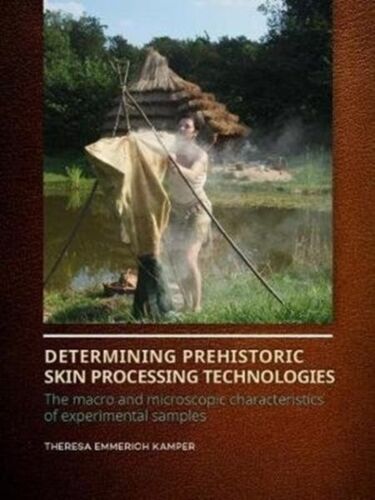
Determining Prehistoric Skin Processing Technologies - Emmerich Kamper, Theresa
- Format: Broché Voir le descriptif
Vous en avez un à vendre ?
Vendez-le-vôtre107,20 €
Produit Neuf
Ou 26,80 € /mois
- Livraison : 5,00 €
- Livré entre le 24 et le 29 juillet
Exp¿di¿ en 6 jours ouvr¿s

- Payez directement sur Rakuten (CB, PayPal, 4xCB...)
- Récupérez le produit directement chez le vendeur
- Rakuten vous rembourse en cas de problème

Gratuit et sans engagement
Félicitations !
Nous sommes heureux de vous compter parmi nos membres du Club Rakuten !
TROUVER UN MAGASIN
Retour
Avis sur Determining Prehistoric Skin Processing Technologies Format Broché - Livre Histoire
0 avis sur Determining Prehistoric Skin Processing Technologies Format Broché - Livre Histoire
Les avis publiés font l'objet d'un contrôle automatisé de Rakuten.
-
Vouet: Grand Palais 6 Novembre 1990 11 Février 1991
Occasion dès 150,00 €
-
Miyoko Ihara - Misao The Big Mama And Fukumaru The Cat
Occasion dès 65,00 €
-
Oxford Resources For Ib Dp Chemistry: Study Guide
Neuf dès 54,16 €
-
Just Enough Software Architecture: A Risk-Driven Approach
Occasion dès 142,99 €
-
St - Tropez Soleil
1 avis
Neuf dès 105,00 €
-
La Sante Interdite
1 avis
Occasion dès 71,00 €
-
The Mirabelle Cookbook
Occasion dès 98,08 €
-
Dji Osmo 4 : 4k/240fps3activetrack
Neuf dès 85,99 €
-
Cambridge English Proficiency 2 Student's Book With Answers With Audio
Neuf dès 91,64 €
-
Anders Petersen, Rome
Occasion dès 65,00 €
-
Gilbert Portanier
Neuf dès 141,34 €
-
Art And Devotion At A Buddhist Temple In The Indian Himalaya
Neuf dès 73,00 €
-
500+ Ukrainian Verbs
Neuf dès 69,69 €
-
Liberalism And The Limits Of Justice
Neuf dès 61,74 €
-
Medieval Military Technology, Second Edition
Neuf dès 62,76 €
-
Rivstart A1 + A2 Textbok
Occasion dès 55,22 €
-
Pete Townshend: Who I Am
Neuf dès 127,99 €
-
Georgia O'keeffe
Occasion dès 105,99 €
-
English Collocations In Use Intermediate Book With Answers
Neuf dès 59,12 €
-
A First Course In Logic
Neuf dès 130,46 €
Occasion dès 192,99 €
Produits similaires
Présentation Determining Prehistoric Skin Processing Technologies Format Broché
- Livre Histoire


Résumé :
The importance of skin processing technologies in the history and expansion of humankind cannot be overstated, yet these technologies can be difficult to identify in the archaeological record. This research outlines the development of a systematic, non-destructive method for identifying the tanning technologies used to produce prehistoric skin artefacts. The approach combines extensive archaeological research and over 25 years of the author?s personal tanning experience. The method employs observations of an extensive sample reference collection, both macroscopic and microscopic, to produce a database of defining characteristics for six tannage types, from a large geographic area and time frame. The primary collection contains 22 species identified as economically important from both Europe and North America. A secondary collection of clothing and utilitarian items, made from traditionally processed skins, was used to add ?in-life use? traces to the database. The method was tested against both archaeological items from a variety of preservation contexts, and ethnographic items from museum collections across North America and Europe. This analysis confirmed that defining characteristics do exist between the primary tannage technologies, and that at least some defining characteristics survived in all preservation contexts. These can be recorded at multiple levels of observation, and often provide insight into small sections of the artefact?s production sequence and life history. This research shows definitively that processed skin items from vastly different preservation contexts can provide a wealth of information about prehistoric tannage technologies, as well as information on manufacturing sequences and the conditions of use an item experienced. The method is a valuable analytical tool for those involved in conservation, curation or analysis of archaeological or ethnographic skin products. It provides a consolidated source of information for artisans working with traditional tanning, or re-enactors interested in the history or science of skin products. Finally, it serves as an example of the targeted use of experimental archaeology in a large-scale research project, and will be beneficial to anyone involved in experimental or experiential archaeology. Contents Preface Chapter 1: Connecting disciplines and traditions in archaeological skin processing Chapter 2: Methodologies for investigating early tanning technologies Chapter 3: Rationale for faunal selection Chapter 4: Methodology for chosen tanning technologies Chapter 5: Analysis of experimental reference sample collection Chapter 6: Collection analysis by tannage: Interpretation of results Chapter 7: Identification of in-life use traces Chapter 8: Tying it all together: discriminating traits by tannage type Chapter 9: Discussion and conclusions Appendices Glossary Bibliography
Biographie:
Dr. Theresa Emmerich Kamper is an avid practitioner of traditional living skills and primitive technology of all kinds, and has tanned skins using traditional technologies for over twenty five years. She holds a Masters Degree in Experimental Archaeology from the University of Exeter, as well as a PhD on the microscopic analysis of prehistoric processed skin artefacts. She is currently an honorary research fellow with the University of Exeter and teaches practical courses across Europe, North America and the Near East on various tannage technologies as well as continuing to engage in research projects with a broad array of museum and academic institutions.
Détails de conformité du produit
Personne responsable dans l'UE