
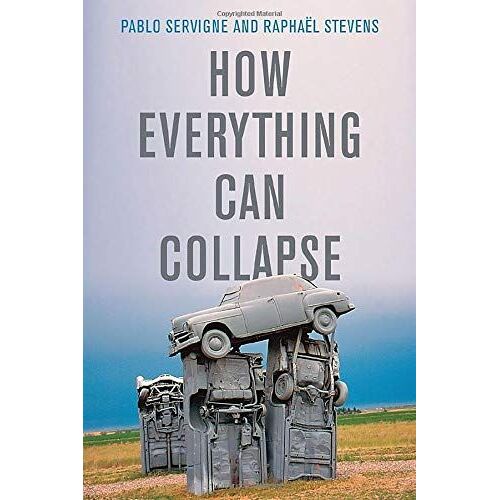
How Everything Can Collapse - Pablo Servigne
- Format: Broché Voir le descriptif
Vous en avez un à vendre ?
Vendez-le-vôtreExpédition rapide et soignée depuis l`Angleterre - Délai de livraison: entre 10 et 20 jours ouvrés.
Nos autres offres
-
21,45 €
Produit Neuf
- Livraison à 0,01 €
- Livré entre le 5 et le 15 juin
Brand new, In English, Fast shipping from London, UK; Tout neuf, en anglais, expédition rapide depuis Londres, Royaume-Uni;ria9781509541393_dbm
Voir le détail de l'annonce -
21,74 €
Produit Neuf
- Livraison à 0,01 €
Nouvel article expédié dans le 24H à partir des Etats Unis Livraison au bout de 20 à 30 jours ouvrables.
Voir le détail de l'annonce -
22,03 €
Produit Neuf
- Livraison : 3,99 €
- Livré entre le 4 et le 9 juin
Voir le détail de l'annonce -
27,79 €
Produit Neuf
- Livraison : 5,00 €
- Livré entre le 5 et le 10 juin
Exp¿di¿ en 7 jours ouvr¿s
Voir le détail de l'annonce

- Payez directement sur Rakuten (CB, PayPal, 4xCB...)
- Récupérez le produit directement chez le vendeur
- Rakuten vous rembourse en cas de problème

Gratuit et sans engagement
Félicitations !
Nous sommes heureux de vous compter parmi nos membres du Club Rakuten !
TROUVER UN MAGASIN
Retour
Avis sur How Everything Can Collapse de Pablo Servigne Format Broché - Livre
0 avis sur How Everything Can Collapse de Pablo Servigne Format Broché - Livre
Les avis publiés font l'objet d'un contrôle automatisé de Rakuten.
Présentation How Everything Can Collapse de Pablo Servigne Format Broché
- Livre


Résumé :
What if our civilization were to collapse? Not many centuries into the future, but in our own lifetimes? Most people recognize that we face huge challenges today, from climate change and its potentially catastrophic consequences to a plethora of socio-political problems, but we find it hard to face up to the very real possibility that these crises could produce a collapse of our entire civilization. Yet we now have a great deal of evidence to suggest that we are up against growing systemic instabilities that pose a serious threat to the capacity of human populations to maintain themselves in a sustainable environment. In this important book, Pablo Servigne and Rapha?l Stevens confront these issues head-on. They examine the scientific evidence and show how its findings, often presented in a detached and abstract way, are connected to people's ordinary experiences - joining the dots, as it were, between the Anthropocene and our everyday lives. In so doing they provide a valuable guide that will help everyone make sense of the new and potentially catastrophic situation in which we now find ourselves. Today, utopia has changed sides: it is the utopians who believe that everything can continue as before, while realists put their energy into making a transition and building local resilience. Collapse is the horizon of our generation. But collapse is not the end - it's the beginning of our future. We will reinvent new ways of living in the world and being attentive to ourselves, to other human beings and to all our fellow creatures....
Biographie:
..
Sommaire:
What if our civilization were to collapse? Not many centuries into the future, but in our own lifetimes? Most people recognize that we face huge challenges today, from climate change and its potentially catastrophic consequences to a plethora of socio-political problems, but we find it hard to face up to the very real possibility that these crises could produce a collapse of our entire civilization. Yet we now have a great deal of evidence to suggest that we are up against growing systemic instabilities that pose a serious threat to the capacity of human populations to maintain themselves in a sustainable environment. In this important book, Pablo Servigne and Rapha?l Stevens confront these issues head-on. They examine the scientific evidence and show how its findings, often presented in a detached and abstract way, are connected to people's ordinary experiences - joining the dots, as it were, between the Anthropocene and our everyday lives. In so doing they provide a valuable guide that will help everyone make sense of the new and potentially catastrophic situation in which we now find ourselves. Today, utopia has changed sides: it is the utopians who believe that everything can continue as before, while realists put their energy into making a transition and building local resilience. Collapse is the horizon of our generation. But collapse is not the end - it's the beginning of our future. We will reinvent new ways of living in the world and being attentive to ourselves, to other human beings and to all our fellow creatures....
Détails de conformité du produit
Personne responsable dans l'UE