
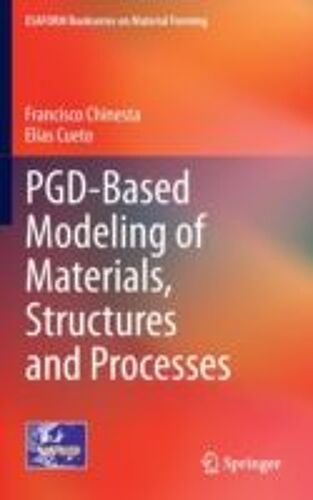
PGD-Based Modeling of Materials, Structures and Processes - Cueto, Elías
- Format: Relié Voir le descriptif
Vous en avez un à vendre ?
Vendez-le-vôtre136,83 €
Produit Neuf
Ou 34,21 € /mois
- Livraison à 0,01 €
- Livré entre le 30 mai et le 8 juin
Brand new, In English, Fast shipping from London, UK; Tout neuf, en anglais, expédition rapide depuis Londres, Royaume-Uni;ria9783319061818_dbm

- Payez directement sur Rakuten (CB, PayPal, 4xCB...)
- Récupérez le produit directement chez le vendeur
- Rakuten vous rembourse en cas de problème

Gratuit et sans engagement
Félicitations !
Nous sommes heureux de vous compter parmi nos membres du Club Rakuten !
TROUVER UN MAGASIN
Retour
Avis sur Pgd - Based Modeling Of Materials, Structures And Processes Format Relié - Livre Loisirs
0 avis sur Pgd - Based Modeling Of Materials, Structures And Processes Format Relié - Livre Loisirs
Les avis publiés font l'objet d'un contrôle automatisé de Rakuten.
-
Supergirl: The New 52 Omnibus Vol. 1
Neuf dès 129,55 €
-
The Emergence Of Modern Business Enterprise In France, 1800-1930 Harvard Studies In Business History
Neuf dès 108,81 €
-
Portfolio Joubert "Les Scouts"
Occasion dès 75,00 €
-
The Lines Of My Hand
1 avis
Occasion dès 79,00 €
-
Corporate Finance
Neuf dès 87,89 €
-
Moonwalk By Michael Jackson
2 avis
Occasion dès 70,46 €
-
Saul Steinberg | Harold Rosenberg
Occasion dès 103,99 €
-
20000 Years Of Fashion
Occasion dès 152,99 €
-
Hyperbolic Geometry From A Local Viewpoint
Neuf dès 77,99 €
-
Calvin Klein
Neuf dès 195,00 €
-
In The American West 40th Anniversary Edition
1 avis
Neuf dès 82,19 €
Occasion dès 192,09 €
-
The Philip K. Dick Collection
Neuf dès 109,00 €
-
Conformal Field Theory
Neuf dès 192,29 €
-
Rebus
Occasion dès 83,65 €
-
Molyneux
Occasion dès 78,95 €
-
Bruegel. The Complete Works
Neuf dès 95,23 €
-
Encyclopedie Musicale Michael Jackson
6 avis
Occasion dès 115,00 €
-
Instability, Skew-T & Hodograph Handbook
Neuf dès 87,10 €
-
Ice Cold - A Hip-Hop Jewelry History
1 avis
Neuf dès 80,00 €
-
Fotografias 1976 - 2003 Photographs 1976 - 2003
Occasion dès 120,00 €
Produits similaires
Présentation Pgd - Based Modeling Of Materials, Structures And Processes Format Relié
- Livre Loisirs


Résumé :
This book focuses on the development of a new simulation paradigm allowing for the solution of models that up to now have never been resolved and which result in spectacular CPU time savings (in the order of millions) that, combined with supercomputing, could revolutionize future ICT (information and communication technologies) at the heart of science and technology. The authors have recently proposed a new paradigm for simulation-based engineering sciences called Proper Generalized Decomposition, PGD, which has proved a tremendous potential in many aspects of forming process simulation. In this book a review of the basics of the technique is made, together with different examples of application.
Sommaire: 1 Introduction.- 1.1 Recurrent issues in numerical simulation.- 1.2 Model reduction: information versus relevant information.- 1.3 PGD at a glance.- 1.4 Revisiting the simulation challenges.- 1.5 A brief state of the art on PGD-based model order reduction.- 2 Multiscale modelling.- 2.1 From quantum mechanics to kinetic theory.- 2.2 Advanced solvers for multi-dimensional models.- 2.3 Numerical examples.- 2.4 Conclusions.- 3 Homogenization.- 3.1 Homogenization of linear heterogenous models.- 3.2 Non-concurrent nonlinear homogenization.- 3.3 Numerical examples.- 3.4 Conclusions.- 4 Coupled models.- 4.1 Efficient coupling of global and local models.- 4.2 Fully globalized local models.- 4.3 Heterogeneous time integration.- 4.4 Numerical example.- 4.5 Discussion.- 5 Parametric models in evolving domains.- 5.1 Evolving domains issues.- 5.2 PGD in evolving domains.- 5.3 Separated representation constructor.- 5.4 Numerical test.- 5.5 Towards parametric modeling in evolving domains.- 5.6 Numerical test involving parametric modeling.- 5.7 Conclusions.- 6 Space separation.- 6.1 In-plane/out-of-plane separated representation.- 6.2 Laminates.- 6.3 Conclusions.- 7 Process optimization.- 7.1 Parametric boundary conditions.- 7.2 Parametric modeling of pultrusion.- 7.3 Optimization strategy.- 7.4 Conclusion 8 Shape optimization.- 8.1 Introduction.- 8.2 Geometrical parameters as extra-coordinates.- 8.3 Numerical results.- 8.4 Conclusions.- 9 DDDAS.- 9.1 Introduction to DDDAS.- 9.2 PGD solution of a flowing process.- 9.3 Simulating a breakdown scenario.- 9.4 Post-processing in a smartphone.- 9.5 Conclusions.- 10 Inverse analysis.- 10.1 PGD based parameter identification.- 10.2 PGD based Cauchy's problem.- 10.3 Parameter identification examples.- 10.4 Cauchy's problem example.- 10.5 Conclusions.- 11 Tape placement.- 11.1 Parametric modeling.- 11.2 ATP thermal model.- 11.3 ATP mechanical modeling.- 11.4 Numerical results.- 11.5 Conclusions.- 12 Augmented learning.- 12.1 Towards augmented learning.- 12.2 Examples of augmented learning.- 12.3 Conclusions.- References.- Index.
Détails de conformité du produit
Personne responsable dans l'UE