
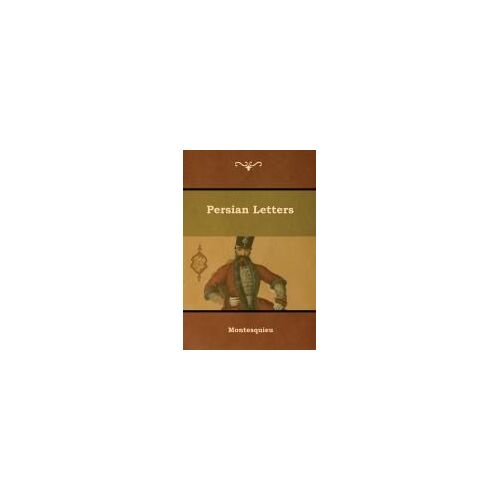
Persian Letters - Montesquieu
- Format: Broché Voir le descriptif
Vous en avez un à vendre ?
Vendez-le-vôtre37,56 €
Produit Neuf
Ou 9,39 € /mois
- Livraison à 0,01 €
- Livré entre le 1 et le 13 août
Brand new, In English, Fast shipping from London, UK; Tout neuf, en anglais, expédition rapide depuis Londres, Royaume-Uni;ria9781618955043_dbm

- Payez directement sur Rakuten (CB, PayPal, 4xCB...)
- Récupérez le produit directement chez le vendeur
- Rakuten vous rembourse en cas de problème

Gratuit et sans engagement
Félicitations !
Nous sommes heureux de vous compter parmi nos membres du Club Rakuten !
TROUVER UN MAGASIN
Retour
Avis sur Persian Letters de Montesquieu Format Broché - Livre Humour
0 avis sur Persian Letters de Montesquieu Format Broché - Livre Humour
Les avis publiés font l'objet d'un contrôle automatisé de Rakuten.
Présentation Persian Letters de Montesquieu Format Broché
- Livre Humour


Résumé :
Charles-Louis de Secondat, Baron de La Br?de et de Montesquieu (18 January 1689 - 10 February 1755), generally referred to as simply Montesquieu, was a French judge, man of letters, and political philosopher. He is famous for his articulation of the theory of separation of powers, which is implemented in many constitutions throughout the world. He is also known for doing more than any other author to secure the place of the word despotism in the political lexicon. His anonymously published The Spirit of the Laws in 1748, which was received well in both Great Britain and the American colonies, influenced the Founding Fathers in drafting the United States Constitution. Persian Letters (French: Lettres persanes) is a literary work, written in 1721, by Montesquieu, recounting the experiences of two Persian noblemen, Usbek and Rica, who are traveling through France. In 1711 Usbek leaves his seraglio in Isfahan to take the long journey to France, accompanied by his young friend Rica. He leaves behind five wives (Zashi, Z?phis, Fatm?, Z?lis, and Roxane) in the care of a number of black eunuchs, one of whom is the head or first eunuch. During the trip and their long stay in Paris (1712-1720), they comment, in letters exchanged with friends and mullahs, on numerous aspects of Western, Christian society, particularly French politics and Moors, ending with a biting satire of the System of John Law. Over time, various disorders surface back in the seraglio, and, beginning in 1717 (Letter 139 [147]), the situation there rapidly unravels. Usbek orders his head eunuch to crack down, but his message does not arrive in time, and a revolt brings about the death of his wives, including the vengeful suicide of his favorite, Roxane, and, it appears, most of the eunuchs. (wikipedia.org)
Biographie:
de et de Montesquieu (18 January 1689 &ndash...
Sommaire:
Charles-Louis de Secondat, Baron de La Brè...
Détails de conformité du produit
Personne responsable dans l'UE