
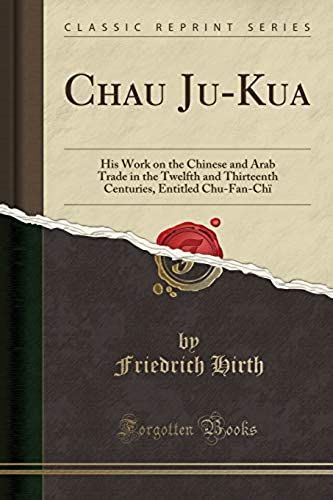
Hirth, F: Chau Ju-Kua -
- Format: Broché Voir le descriptif
Vous en avez un à vendre ?
Vendez-le-vôtreSoyez informé(e) par e-mail dès l'arrivée de cet article
Créer une alerte prix
- Payez directement sur Rakuten (CB, PayPal, 4xCB...)
- Récupérez le produit directement chez le vendeur
- Rakuten vous rembourse en cas de problème

Gratuit et sans engagement
Félicitations !
Nous sommes heureux de vous compter parmi nos membres du Club Rakuten !
TROUVER UN MAGASIN
Retour
Avis sur Hirth, F: Chau Ju - Kua Format Broché - Livre
0 avis sur Hirth, F: Chau Ju - Kua Format Broché - Livre
Les avis publiés font l'objet d'un contrôle automatisé de Rakuten.
Présentation Hirth, F: Chau Ju - Kua Format Broché
- Livre


Résumé :
Excerpt from Chau Ju-Kua: His Work on the Chinese and Arab Trade in the Twelfth and Thirteenth Centuries, Entitled Chu-Fan-Chi?
When King Solomon, in the early part of the tenth century B. C., had opened relations with the Sabeans of the Southern coast of Arabia, the land of Punt of the Egyptians, he sent his ships from the head of the Red Sea to the land of Ophir, -generally believed to have been Guzerat or the Malabar coast. Already at that remote time trade by sea was active between the ports on the south coast of Arabia, the principal of which was where Aden now stands, and Western India. The ships of the Sabeans carried the products of Arabia and India to the heads of the Red Sea and the Persian Gulf. By the former route they reached the cities of the Phoenicians; by the latter they came to Media and Nineveh.
About the Publisher
Forgotten Books publishes hundreds of thousands of rare and classic books. Find more at www.forgottenbooks.com
This book is a reproduction of an important historical work. Forgotten Books uses state-of-the-art technology to digitally reconstruct the work, preserving the original format whilst repairing imperfections present in the aged copy. In rare cases, an imperfection in the original, such as a blemish or missing page, may be replicated in our edition. We do, however, repair the vast majority of imperfections successfully; any imperfections that remain are intentionally left to preserve the state of such historical works.