
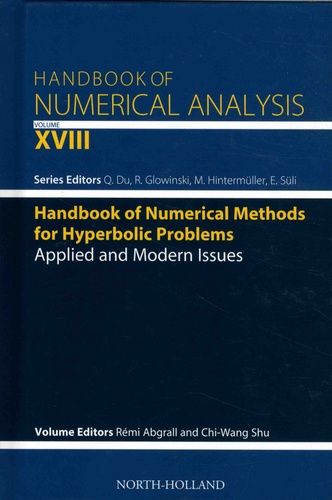
Handbook Of Numerical Methods For Hyperbolic Problems - Applied And Modern Issues - Collectif null
- Collection: Handbook Of Numerical Analysis
- Format: Beau livre Voir le descriptif
Vous en avez un à vendre ?
Vendez-le-vôtreSoyez informé(e) par e-mail dès l'arrivée de cet article
Créer une alerte prix
- Payez directement sur Rakuten (CB, PayPal, 4xCB...)
- Récupérez le produit directement chez le vendeur
- Rakuten vous rembourse en cas de problème

Gratuit et sans engagement
Félicitations !
Nous sommes heureux de vous compter parmi nos membres du Club Rakuten !
TROUVER UN MAGASIN
Retour
Avis sur Handbook Of Numerical Methods For Hyperbolic Problems - Applied And Modern Issues de Collectif null Format Beau... - Livre Mathématiques
0 avis sur Handbook Of Numerical Methods For Hyperbolic Problems - Applied And Modern Issues de Collectif null Format Beau... - Livre Mathématiques
Les avis publiés font l'objet d'un contrôle automatisé de Rakuten.
Présentation Handbook Of Numerical Methods For Hyperbolic Problems - Applied And Modern Issues de Collectif null Format Beau...
- Livre Mathématiques

Résumé :
Hyperbolic partial differential equations arise in numerous applications, the most important of these being fluid dynamics, including specific flows, such as multiphase flows, magneto-hydrodynamics and water waves. Other application areas include electromagnetism, kinetic theory, astrophysics, and traffic flow models and networks. Solutions to hyperbolic partial differential equations often exhibit discontinuities, which makes their mathematical analysis and numerical approximation difficult. Over the last few decades, a large body of literature has emerged on the design, analysis and application of various numerical algorithms for the approximate solution of hyperbolic equations. This is the second of two volumes in which experts in different types of algorithms provide concise summaries in order to acquaint the reader with a range of numerical techniques, in a variety of different situations, and survey their relative advantages and limitations. While the first volume addresses basic and fundamental questions concerning numerical methods for hyperbolic problems, this second volume focuses on more applied topics.
©