
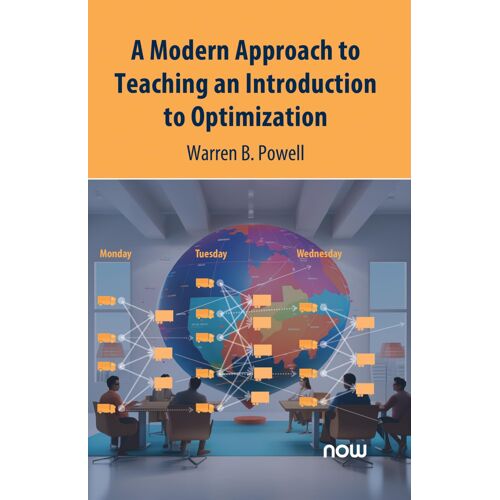
A Modern Approach to Teaching an Introduction to Optimization - Powell, Warren B.
- Format: Relié Voir le descriptif
Nouvel article expédié dans le 24H à partir des Etats Unis Livraison au bout de 20 à 30 jours ouvrables.

- Payez directement sur Rakuten (CB, PayPal, 4xCB...)
- Récupérez le produit directement chez le vendeur
- Rakuten vous rembourse en cas de problème

Gratuit et sans engagement
Félicitations !
Nous sommes heureux de vous compter parmi nos membres du Club Rakuten !
TROUVER UN MAGASIN
Retour
Avis sur A Modern Approach To Teaching An Introduction To Optimization Format Relié - Livre Informatique
0 avis sur A Modern Approach To Teaching An Introduction To Optimization Format Relié - Livre Informatique
Les avis publiés font l'objet d'un contrôle automatisé de Rakuten.
-
Design For Motion
Neuf dès 104,46 €
-
Car Racing 1971
Neuf dès 129,00 €
-
Last Resort: Photographs Of New Brighton
Occasion dès 139,90 €
-
Ellen Von Unwerth. Heimat
Neuf dès 98,04 €
-
Georg Baselitz
Neuf dès 137,45 €
Occasion dès 91,61 €
-
The Evolution Of Complexity By Means Of Natural Selection
Neuf dès 136,68 €
-
L'italien B2 - Pack Avec 1 Livre (3 Cd Audio)
1 avis
Neuf dès 65,90 €
Occasion dès 191,71 €
-
Dictionnaire Chinois - Anglais
Occasion dès 99,00 €
-
A Dictionary Of Wonders: Van Cleef & Arpels
Neuf dès 107,87 €
Occasion dès 76,00 €
-
Dynamo 1 Workbook A (Pack Of 8)
Neuf dès 70,77 €
-
Te Linde's Operative Gynecology
Neuf dès 103,99 €
-
Collection Entremets & Petits Gâteaux
1 avis
Occasion dès 90,00 €
-
Lexique Multilingue - Pâtisserie, Boulangerie, Chocolaterie-Confiserie, Glacerie
2 avis
Occasion dès 140,00 €
-
Throne Of Glass Box Set (Paperback)
Neuf dès 84,00 €
Occasion dès 239,59 €
-
Laboratory Medicine In Psychiatry And Behavioral Science
Neuf dès 125,20 €
-
La Meute De Chânais Tome 9 (Le Dernier Tome De La Saga D'une Meute Pas Comme Les Autres !): Duncan - L'accusation
Occasion dès 65,88 €
-
12 Division Headquarters, Branches And Services Royal Army Medical Corps Assistant Director Medical Services
Neuf dès 90,80 €
-
By Marc Pairon Art Deco Ceramics Made In Belgium: Charles Catteau
6 avis
Occasion dès 110,00 €
-
Shade, The Changing Man By Peter Milligan And Chris Bachalo Omnibus Vol. 1
Neuf dès 128,81 €
-
The Book Of Tiki: The Cult Of Polynesian Pop In Fifties America (Taschen Specials)
Occasion dès 117,99 €
Produits similaires
Présentation A Modern Approach To Teaching An Introduction To Optimization Format Relié
- Livre Informatique


Résumé :
Optimization should be the science of making the best possible decisions. Making decisions is a virtually universal human activity encountered by professionals (in any field) or people in their everyday lives. You would think, then, that the study of making good decisions is a subject that should be taught broadly to students throughout engineering, the physical and social sciences, business, and policy. Yet today, optimization is widely taught as a mathematically sophisticated subject, often limited to graduate students in specialized fields. In operations research (or industrial engineering), optimization is equivalent to deterministic math programming, starting with linear programs (and the simplex algorithm), and then transitioning through integer linear programs and nonlinear programs. If you are in departments like electrical or mechanical engineering, optimization means teaching optimal control. And if you are in computer science, optimization today could be interpreted in the context of machine learning (such as fitting models to data) or as reinforcement learning. This book claims that the traditional style of teaching optimization is misguided and out of date. First, while the simplex algorithm is a powerful strategy for solving linear programs, the details of the simplex algorithm are completely inappropriate in an introductory course in optimization. Second, while linear programs are appropriate for solving many problems, they are only applicable to a tiny fraction of all decisions. Third, linear programs (along with integer and nonlinear programs) are static models for problems with (typically) vector-valued decisions. By contrast, most decisions are sequential since they are made periodically over time as new information is arriving. In addition, the vast majority of these decisions are scalar (possibly continuous or discrete). This book is designed for instructors (or potential instructors) looking to introduce the science of making good decisions to the broadest possible audience. It should also be of interest to anyone who has already had a traditional course in optimization of any type. The presentation is organized around a series of topics that suggest a fundamentally different approach to teaching optimization spanning both sequential decision problems (which offer the simplest problem settings) before transitioning to more complex vector-valued decisions. It also makes the case that most problems which are modeled as linear (or integer, or nonlinear programs) are actually methods for making decisions in a sequential setting. For this reason, these topics are introduced with much less emphasis on algorithms than is traditionally used, both in static and sequential settings....
Biographie:
Warren B. Powell is Professor Emeritus at Princeton University, where he taught for 39 years, and is currently Chief Analytics Officer at Optimal Dynamics. He is the founder and director of CASTLE Labs, which developed models and algorithms in stochastic optimization, with applications to energy systems, transportation, health, e-commerce, and the laboratory sciences (see www.castlelab.princeton.edu). He has pioneered the use of approximate dynamic programming for high-dimensional applications, and the knowledge gradient for active learning problems. His recent work has focused on developing a unified framework for sequential decision problems under uncertainty, spanning active learning to a wide range of dynamic resource allocation problems. He has authored books on Approximate Dynamic Programming and (with Ilya Ryzhov) Optimal Learning, and is the author of Reinforcement Learning and Stochastic Optimization: A unified framework for sequential decisions....
Sommaire:
Optimization should be the science of making the best possible decisions. Making decisions is a virtually universal human activity encountered by professionals (in any field) or people in their everyday lives. You would think, then, that the study of making good decisions is a subject that should be taught broadly to students throughout engineering, the physical and social sciences, business, and policy. Yet today, optimization is widely taught as a mathematically sophisticated subject, often limited to graduate students in specialized fields. In operations research (or industrial engineering), optimization is equivalent to deterministic math programming, starting with linear programs (and the simplex algorithm), and then transitioning through integer linear programs and nonlinear programs. If you are in departments like electrical or mechanical engineering, optimization means teaching optimal control. And if you are in computer science, optimization today could be interpreted in the context of machine learning (such as fitting models to data) or as reinforcement learning. This book claims that the traditional style of teaching optimization is misguided and out of date. First, while the simplex algorithm is a powerful strategy for solving linear programs, the details of the simplex algorithm are completely inappropriate in an introductory course in optimization. Second, while linear programs are appropriate for solving many problems, they are only applicable to a tiny fraction of all decisions. Third, linear programs (along with integer and nonlinear programs) are static models for problems with (typically) vector-valued decisions. By contrast, most decisions are sequential since they are made periodically over time as new information is arriving. In addition, the vast majority of these decisions are scalar (possibly continuous or discrete). This book is designed for instructors (or potential instructors) looking to introduce the science of making good decisions to the broadest possible audience. It should also be of interest to anyone who has already had a traditional course in optimization of any type. The presentation is organized around a series of topics that suggest a fundamentally different approach to teaching optimization spanning both sequential decision problems (which offer the simplest problem settings) before transitioning to more complex vector-valued decisions. It also makes the case that most problems which are modeled as linear (or integer, or nonlinear programs) are actually methods for making decisions in a sequential setting. For this reason, these topics are introduced with much less emphasis on algorithms than is traditionally used, both in static and sequential settings....
Détails de conformité du produit
Personne responsable dans l'UE