
Expédition rapide et soignée depuis l`Angleterre - Délai de livraison: entre 10 et 20 jours ouvrés.
Nos autres offres
-
29,07 €
Produit Neuf
- Livraison : 3,99 €
- Livré entre le 24 et le 31 août
Voir le détail de l'annonce -
42,23 €
Produit Neuf
Ou 10,56 € /mois
- Livraison à 0,01 €
Nouvel article expédié dans le 24H à partir des Etats Unis Livraison au bout de 20 à 30 jours ouvrables.
Voir le détail de l'annonce -
48,66 €
Produit Neuf
Ou 12,17 € /mois
- Livraison à 0,01 €
Expédition rapide et soignée depuis l`Angleterre - Délai de livraison: entre 10 et 20 jours ouvrés.
Voir le détail de l'annonce

- Payez directement sur Rakuten (CB, PayPal, 4xCB...)
- Récupérez le produit directement chez le vendeur
- Rakuten vous rembourse en cas de problème

Gratuit et sans engagement
Félicitations !
Nous sommes heureux de vous compter parmi nos membres du Club Rakuten !
TROUVER UN MAGASIN
Retour
Avis sur Daily Science Grade 3 Te de Format Broché - Livre
0 avis sur Daily Science Grade 3 Te de Format Broché - Livre
Les avis publiés font l'objet d'un contrôle automatisé de Rakuten.
Présentation Daily Science Grade 3 Te de Format Broché
- Livre


Biographie: About Evan-Moor Educational Publishers Our mission is to ignite young minds to help every child learn and succeed!
Evan-Moor creates engaging and meaningful learning resources for children in grades PreK-8. Trusted by parents and teachers for over 45 years, Evan-Moor resources are thoughtfully developed to nurture children's hearts and minds to help them reach their full potential.
We are committed to developing innovative educational PreK-8 resources that create meaningful learning experiences for kids. We take pride in developing award-winning resources that align with current educational standards and best practices while fostering curiosity, critical thinking, and a love of learning in students around the world.
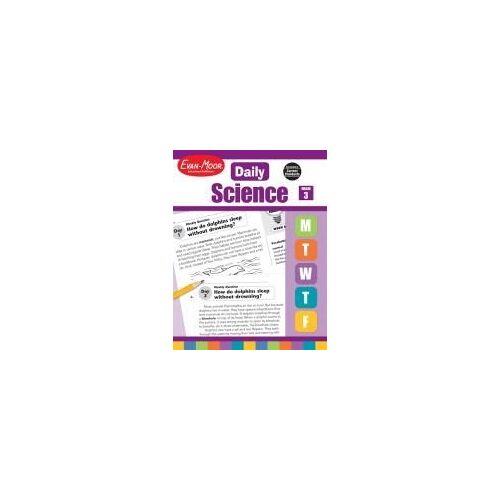
Sommaire: Fit standards-based science instruction into your curriculum! Help your grade 3 students develop a genuine understanding of standards-based scientific concepts and vocabulary using the 150 engaging activities in Daily Science! A variety of rich resources, including vocabulary practice, hands-on science activities, and comprehension tests in multiple-choice format, help you successfully introduce students to earth, life, and physical science concepts. 30 weeks of instruction cover the following standards-based science topics: Big Idea 1: Living things have adaptations that help them survive in their environment. Big Idea 2: Plants have many parts. Each part does a special job. Big Idea 3: Fossils tell us about the plants and animals that lived long ago. Big Idea 4: Air is a gas that surrounds us, takes up space, and creates weather. Big Idea 5: Light moves in a straight line until it hits an object. Light can be absorbed, refracted, or reflected. Big Idea 6: Electricity travels in currents. It can pull and push the things around it. Immerse your third graders to the wonders of physical, life and Earth science with Evan-Moor's Daily Science. This third grade teacher's print edition contains 30 weeks of concentrated science lessons and hands-on activities that give students a solid foundation of standards-based science concepts while helping to improve science literacy. Students will learn and use relevant science vocabulary as they explore the answers to intriguing scientific questions like why do leaves change color in fall and where does wind comes from. Daily Science is an excellent supplement to any third grade science curriculum.
Week 1: Why do flowers have different colors and scents?
Week 2: How do dolphins sleep without drowning?
Week 3: Why does a cactus have needles?
Week 4: Why do birds migrate?
Week 5: Unit Review
Week 1: What's the difference between a fruit and a vegetable?
Week 2: How does a tree get water from its roots to its leaves?
Week 3: Why do dandelions turn white and fluffy?
Week 4: Why do leaves change color in the fall?
Week 5: Unit Review
Week 1: Where is the best place to look for fossils?
Week 2: How do scientists know how old a fossil is?
Week 3: Why are fossils of ocean animals found on mountains today?
Week 4: How does something become a fossil?
Week 5: Unit Review
Week 1: Why can't you breathe in outer space?
Week 2: Why does a can of soda sometimes explode when you open it?
Week 3: Where does wind come from?
Week 4: How do birds fly?
Week 5: Unit Review
Week 1: Why does it get hot in the car on a sunny day when it is cold outside?
Week 2: Why does a straw look bent in a glass of water?
Week 3: Why do things look backward in a mirror?
Week 4: How does a movie projector work?
Week 5: Unit Review
Week 1: Where does lightning come from?
Week 2: Why do people get a shock when they touch metal?
Week 3: How does a battery make electricity?
Week 4: How does flipping a switch make a light bulb light up?
Week 5: Unit Review
Détails de conformité du produit
Personne responsable dans l'UE