
53,70 €
Produit Neuf
Ou 13,43 € /mois
- Livraison à 0,01 €
- Livré entre le 28 août et le 14 septembre
Brand new, In English, Fast shipping from London, UK; Tout neuf, en anglais, expédition rapide depuis Londres, Royaume-Uni;ria9783030986087_dbm
Nos autres offres
-
67,79 €
Produit Neuf
Ou 16,95 € /mois
- Livraison : 3,99 €
- Livré entre le 28 août et le 3 septembre
Voir le détail de l'annonce

- Payez directement sur Rakuten (CB, PayPal, 4xCB...)
- Récupérez le produit directement chez le vendeur
- Rakuten vous rembourse en cas de problème

Gratuit et sans engagement
Félicitations !
Nous sommes heureux de vous compter parmi nos membres du Club Rakuten !
TROUVER UN MAGASIN
Retour
Avis sur Physics Of Molecular And Cellular Processes de Format Broché - Livre Physique - Chimie
0 avis sur Physics Of Molecular And Cellular Processes de Format Broché - Livre Physique - Chimie
Les avis publiés font l'objet d'un contrôle automatisé de Rakuten.
-
Ephemerides 1950-2050 Ut For 0h International Edition
19 avis
Occasion dès 44,95 €
-
Living Beautifully In Paris
Occasion dès 61,75 €
-
Homère, Iliade, Texte Grec Et Traduction Française, Coll. Guillaume Budé, Édition Des Belles Lettres, Tomes I À Iv
Occasion dès 50,00 €
-
Fix-It Phonics - Level 3 - Student Pack (2nd Edition)
Neuf dès 59,72 €
-
Canzoniere Facilotto
Neuf dès 27,99 €
-
English Grammar In Use - With Answers & Ebook
3 avis
Occasion dès 39,30 €
-
Pallas, N° 73/2007 : Identités Ethniques Dans Le Monde Grec Antique
Occasion dès 30,00 €
-
Robert Mapplethorpe Und Die Klassische Tradition : Fotografien Und Manieristische Druckgrafik
Occasion dès 29,69 €
-
Warhammer Invasion: Bleeding Sun Battle Pack
Neuf dès 55,00 €
-
Grammaire Appliquée De L'anglais - Avec Exercices Corrigés
3 avis
Neuf dès 29,00 €
Occasion dès 27,55 €
-
The Lives Of Seaweeds
Neuf dès 49,86 €
-
Open World First Student's Book Without Answers With Online Practice
Neuf dès 73,91 €
Occasion dès 117,61 €
-
Saints At The Limits
Neuf dès 54,44 €
-
Creating Characters With Personality
Neuf dès 28,97 €
-
Vandals: The Photography Of The Bikeriders
Neuf dès 52,09 €
-
Concise Oxford English Dictionary 12th Ed
23 avis
Neuf dès 42,95 €
-
Mastering Pot-Limit Omaha
Neuf dès 35,70 €
-
The Fender Bass
2 avis
Neuf dès 39,10 €
-
Dark City. The Real Los Angeles Noir
Occasion dès 30,00 €
-
101 Things I Learned In Architecture School
Neuf dès 36,74 €
Produits similaires
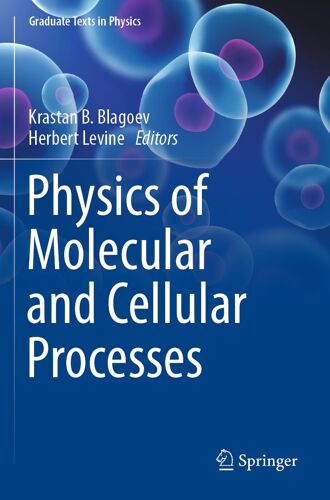
Présentation Physics Of Molecular And Cellular Processes de Format Broché
- Livre Physique - Chimie


Résumé :
Biographie: Krastan B. Blagoev is a Program Director at the US National Science Foundation and is a Research Scientist at the Johns Hopkins University, Department of Biophysics. His research is focused on applying methods of non-equilibrium physics and control theory to gain insight in the function and architecture of living systems. His research has been featured in Physics Today, Physics World, Science Daily, Aznei-News. Blagoev is a Fellow of the American Physical Society. Heworked on the creation and establishment of the International Graduate Student Research Network, The International Physics of Living Systems Teachers Network, and the Cancer Convergence Education Network. Herbert Levine is a Distinguished Professor of Physics and Bioengineering at Northeastern Univ.. He is a pioneer in using theory to expand experimental findings and in the development of well-parameterized computational models that can be used to garner new insights into biological and biomedical systems. Levineis an elected member of the American Academy of Arts and Sciences, an elected member of the National Academy of Science, a fellow of the American Physical Society, and past chair of the American Physical Society's Division of Biological Physics. He is the author of more than 300 peer-reviewed publications. His research has been featured in the New York Times, Scientific American, the Today Show and many other popular science forums. Levine is a co-director of Center for Theoretical Biological Physics, an NSF-sponsored effort to apply physical science to the living world. Also, Dr. Levine is the coordinator of an international network of graduate students conducting research into the Physics of Living Systems.
Sommaire:
Part I. The non-equilibrium nature of living systems.- 1.1 Introduction.- 1.2 Equilibrium and non-equilibrium thermodynamics and statistical physics.- 1.3 Organization and evolution of life.- 1.4 The physics of biomolecules.- 1.5 The physics of proteins: The special role of water. Folding, unfolding and misfolding. Active sites, allostery. Molecular motors (e.g. flagellar motor) and the use of free energy. Protein-protein interactions and their role in cell signaling.- 1.6 Physics of DNA and RNA: Electrostatistics, folding, unfolding, topology, geometry, accessibility. Protein-DNA interactions and chromatin structure.- 1.7 Physics of metabolism: Energy production and charge transport. Network analysis. Bacterial growth laws. Mitochondrial structure and function.- 1.8 Physics of Cytoskeletal proteins. Polymerization kinetics and applications to actin and microtubules. Nucleation dynamics. Kinesin, Dynein and Myosin as non-equilibrium walkers.- 1.9 Physics of Viruses.- Part II. The Physics of the Cell.- 2.1 Physics of the cell membrane: real and model membranes, Helfrich free energy. Embedded protein, including surface receptors. Membrane fusion and fission, application to viral entry, endo- and exo-cytosis.- 2.2 Dynamics in the cell. Transport via passive diffusion versus active transport. Targeting to organelles via molecular signals. Scaffolds and compartments for chemical reaction control. The cytoskeletal network and its role in cell mechanics.- 2.3 Genetic networks. Transcriptional dynamics, examples from phage and bacteria. Control of translation, for example via small RNAs. Role of chromatin structure for eukaryotic systems.- 2.4 Signal transduction: Receptor subtypes (GPCR, Tyrosine kinase, ion channels) and kinetics. Phosphorelay in the Map Kinase pathway. Second messenger dynamics, including amplification in e.g. calcium signaling. Adaptation and chemotacis in bacteria.- Part III. The Physics of the Organism.- 3.1 Cell division - DNA replication. Bacteria cell size determination, contractile ring placement and dynamics; Eukaryotic cell division mitotic spindle, cell cycle checkpoints.- 3.2 DNA damage and repair, chromosome instability, damage checkpoints, telomere dynamics and chromosome instability.- 3.3 Cell motion types of bacterial motion: swimming versus gliding. Crawling of eukaryotic cells; adhesion complexes, active forces due to contraction and polymerization. Chemotaxis and durotaxis.- 3.4 Cellular decisions sporulation in Bacillus,Dictyostelium. Stem cells versus differentiated cells. Landscapes in non-equilibrium systems. The origins of multicellularity.
Détails de conformité du produit
Personne responsable dans l'UE