
156,77 €
Produit Neuf
Ou 39,19 € /mois
- Livraison : 3,99 €
- Livré entre le 24 et le 31 août

- Payez directement sur Rakuten (CB, PayPal, 4xCB...)
- Récupérez le produit directement chez le vendeur
- Rakuten vous rembourse en cas de problème

Gratuit et sans engagement
Félicitations !
Nous sommes heureux de vous compter parmi nos membres du Club Rakuten !
TROUVER UN MAGASIN
Retour
Avis sur Artificial Intelligence For Scientific Discoveries de Iten, Raban Format Relié - Livre Physique - Chimie
0 avis sur Artificial Intelligence For Scientific Discoveries de Iten, Raban Format Relié - Livre Physique - Chimie
Les avis publiés font l'objet d'un contrôle automatisé de Rakuten.
-
Stratified Morse Theory
Neuf dès 191,54 €
-
Design For Motion
Neuf dès 104,46 €
-
Car Racing 1971
Neuf dès 129,00 €
-
Last Resort: Photographs Of New Brighton
Occasion dès 139,90 €
-
Ellen Von Unwerth. Heimat
Neuf dès 98,04 €
-
Eva Hesse
Occasion dès 184,99 €
-
Georg Baselitz
Neuf dès 137,45 €
Occasion dès 91,61 €
-
The Evolution Of Complexity By Means Of Natural Selection
Neuf dès 136,68 €
-
The Religion Of The Mithras Cult In The Roman Empire
Neuf dès 214,66 €
-
Dictionnaire Chinois - Anglais
Occasion dès 99,00 €
-
Te Linde's Operative Gynecology
Neuf dès 103,99 €
-
Collection Entremets & Petits Gâteaux
1 avis
Occasion dès 90,00 €
-
Lexique Multilingue - Pâtisserie, Boulangerie, Chocolaterie-Confiserie, Glacerie
2 avis
Occasion dès 140,00 €
-
Throne Of Glass Box Set (Paperback)
Neuf dès 84,00 €
Occasion dès 239,59 €
-
Laboratory Medicine In Psychiatry And Behavioral Science
Neuf dès 125,20 €
-
Quantum Chemistry, 2nd Edition
1 avis
Neuf dès 227,66 €
-
12 Division Headquarters, Branches And Services Royal Army Medical Corps Assistant Director Medical Services
Neuf dès 90,80 €
-
By Marc Pairon Art Deco Ceramics Made In Belgium: Charles Catteau
6 avis
Occasion dès 110,00 €
-
Shade, The Changing Man By Peter Milligan And Chris Bachalo Omnibus Vol. 1
Neuf dès 128,81 €
-
The Book Of Tiki: The Cult Of Polynesian Pop In Fifties America (Taschen Specials)
Occasion dès 117,99 €
Produits similaires
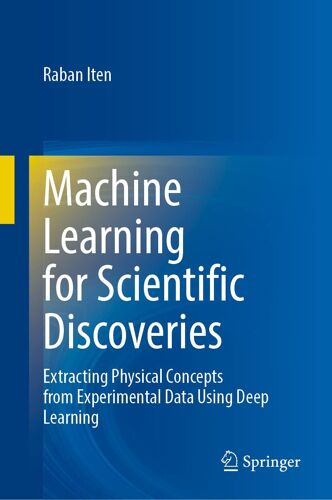
Présentation Artificial Intelligence For Scientific Discoveries de Iten, Raban Format Relié
- Livre Physique - Chimie


Résumé :
Will research soon be done by artificial intelligence, thereby making human researchers superfluous? This book explains modern approaches to discovering physical concepts with machine learning and elucidates their strengths and limitations. The automation of the creation of experimental setups and physical models, as well as model testing are discussed. The focus of the book is the automation of an important step of the model creation, namely finding a minimal number of natural parameters that contain sufficient information to make predictions about the considered system. The basic idea of this approach is to employ a deep learning architecture, SciNet, to model a simplified version of a physicist's reasoning process. SciNet finds the relevant physical parameters, like the mass of a particle, from experimental data and makes predictions based on the parameters found. The author demonstrates how to extract conceptual information from such parameters, e.g., Copernicus' conclusion that the solar system is heliocentric. ...
Biographie:
Raban Iten studied Physics and Mathematics at ETH Z?rich, followed by a Ph.D. in quantum computation. During his Ph.D., he worked on using machine learning to discover physical concepts from experimental data of classical and quantum systems. This work was widely covered in the media and pointed out as a research highlight of 2019 by Nature Reviews Physics. Furthermore, he developed algorithms for quantum compilers and contributed to various open-source libraries for quantum computing. ...
Sommaire:
Will research soon be done by artificial intelligence, thereby making human researchers superfluous? This book explains modern approaches to discovering physical concepts with machine learning and elucidates their strengths and limitations. The automation of the creation of experimental setups and physical models, as well as model testing are discussed. The focus of the book is the automation of an important step of the model creation, namely finding a minimal number of natural parameters that contain sufficient information to make predictions about the considered system. The basic idea of this approach is to employ a deep learning architecture, SciNet, to model a simplified version of a physicist's reasoning process. SciNet finds the relevant physical parameters, like the mass of a particle, from experimental data and makes predictions based on the parameters found. The author demonstrates how to extract conceptual information from such parameters, e.g., Copernicus' conclusion that the solar system is heliocentric. ...
Détails de conformité du produit
Personne responsable dans l'UE